# What Is Döner
Direct answers. German döner is not a gyro.
## What is a German döner?
A German döner is the Berlin-style kebab: meat off a vertical spit, in toasted flatbread, with fresh vegetables and sauce.
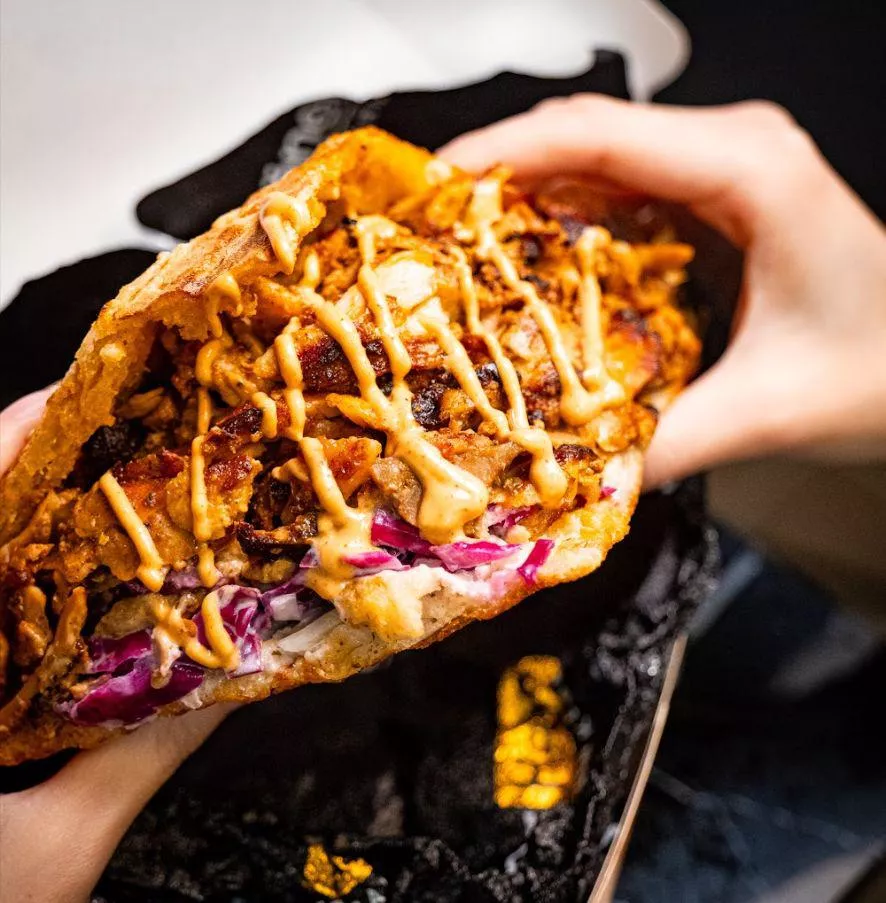
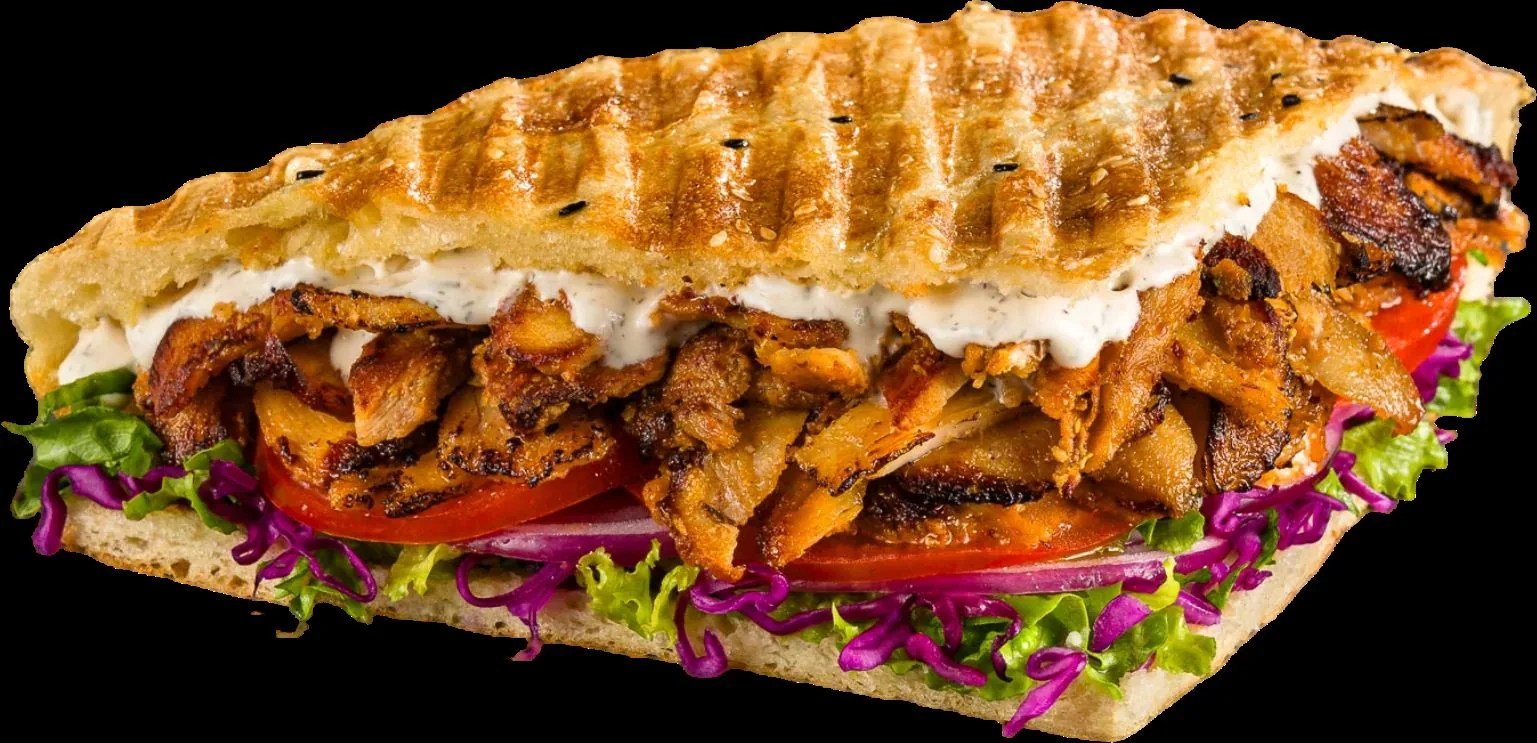
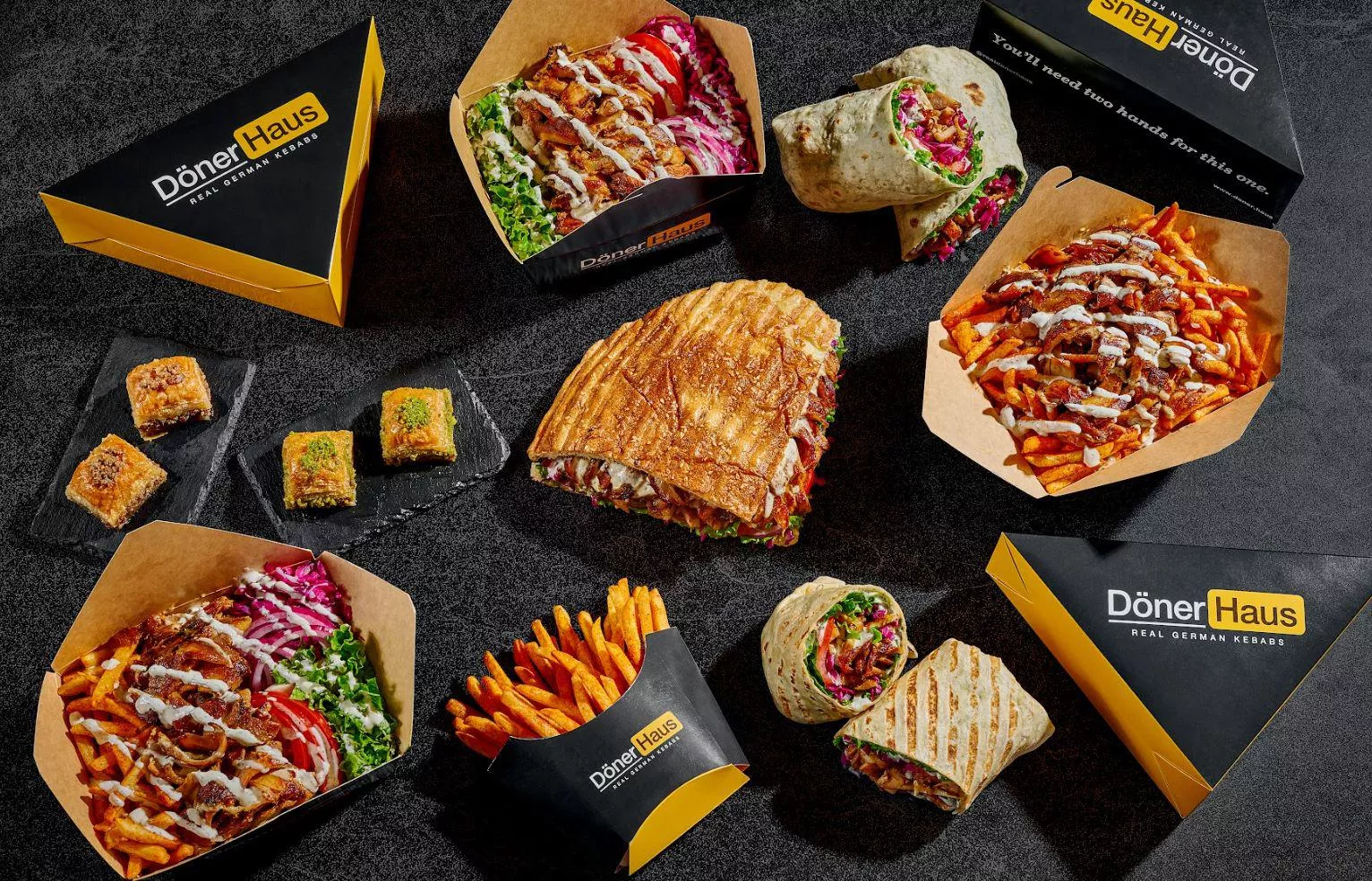
Toasted pide, shaved meat, cabbage, sauce.Sandwich, wrap and box are the same fillings in three builds.
The short version
### Everyday food in Germany. Still uneven in the US. {: .display }
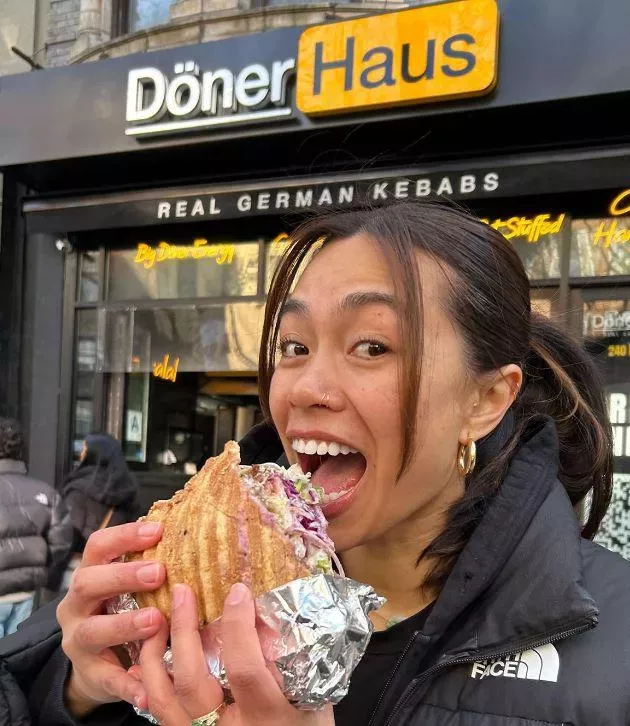
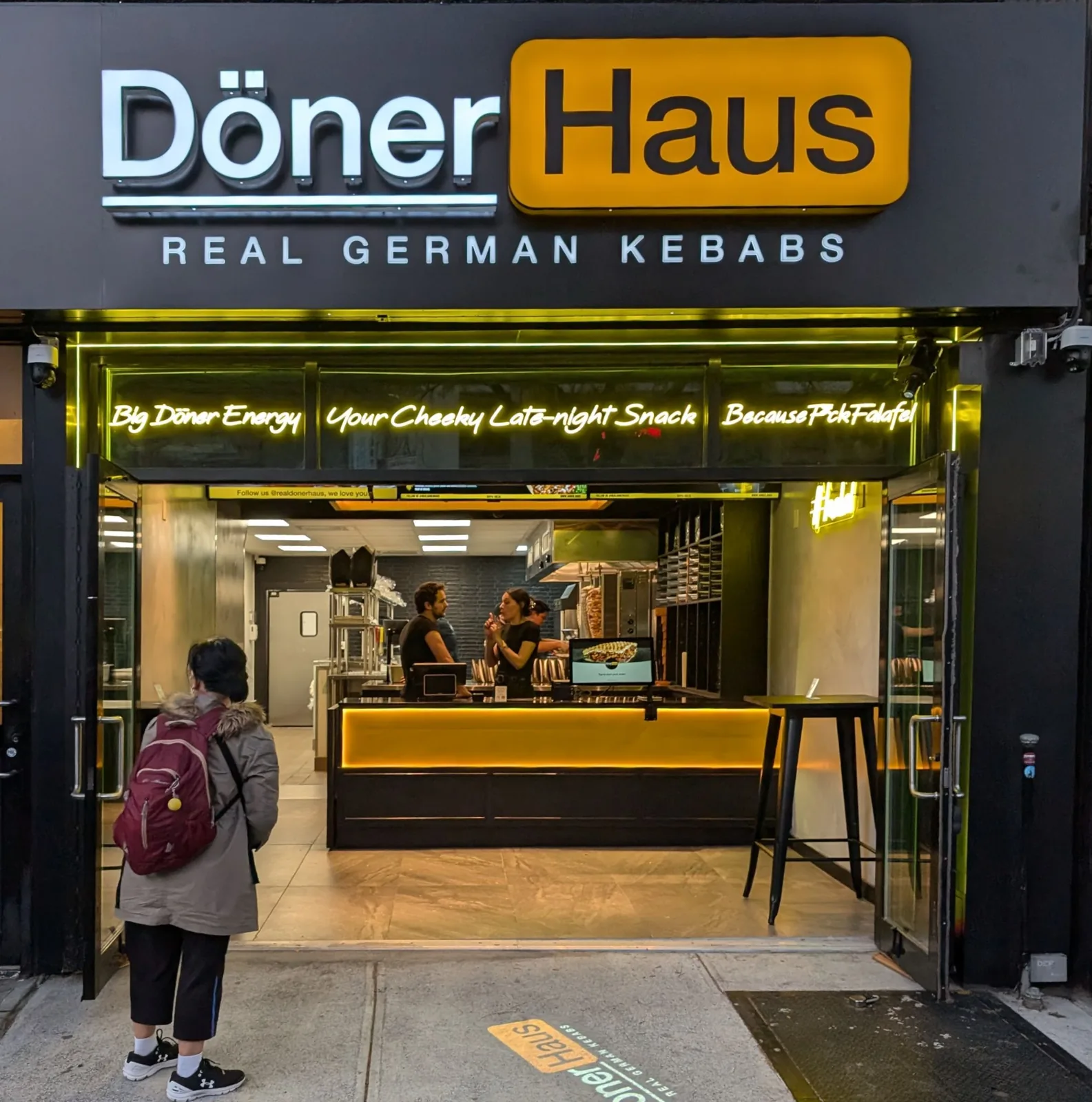
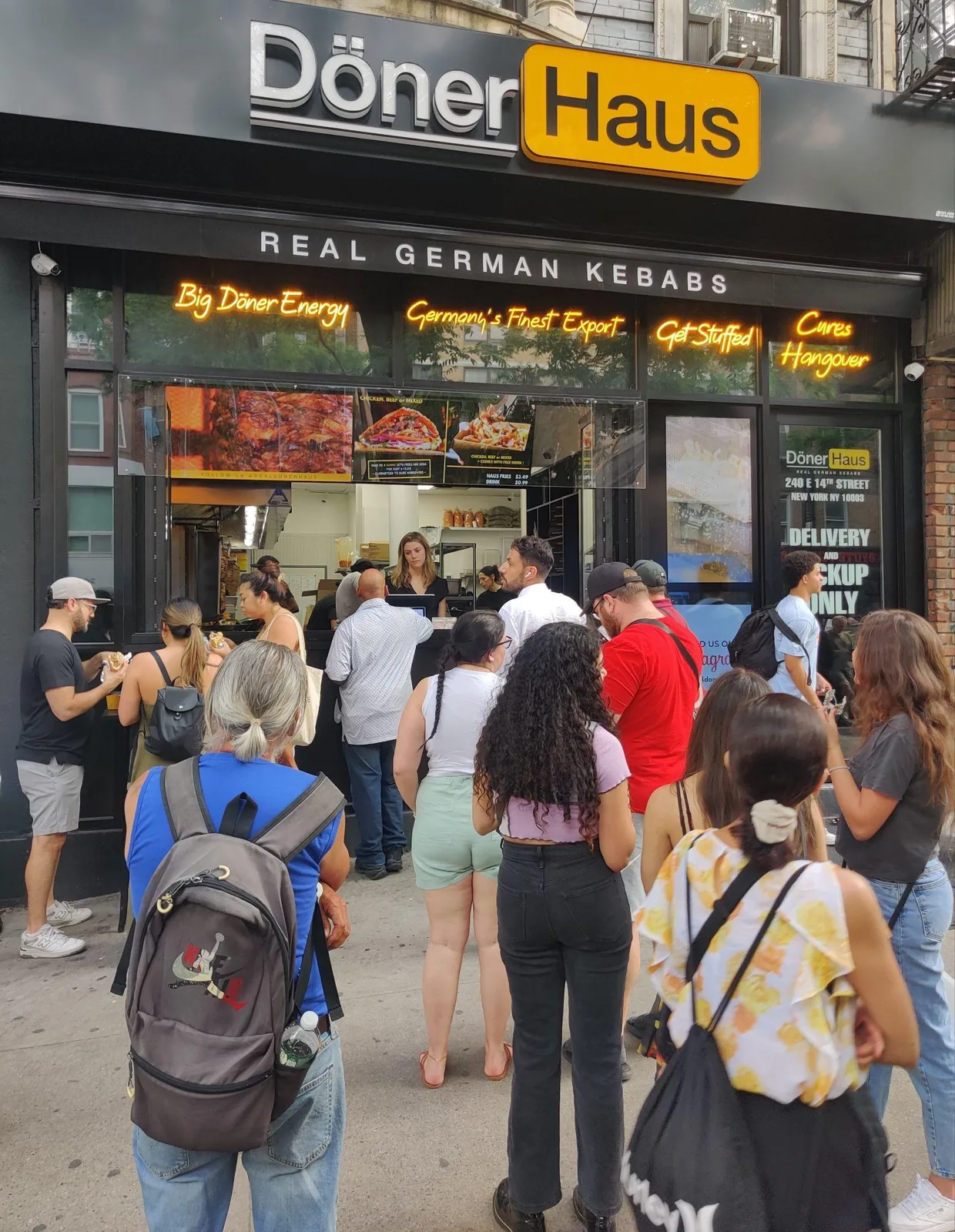
In Germany, döner is everyday food. In the United States the Berlin sandwich is Döner Haus: toasted pide, New York and Los Angeles, more shops signed. GDK is a UK waffle-bread chain. Most cities still have neither.
MethodVertical spit
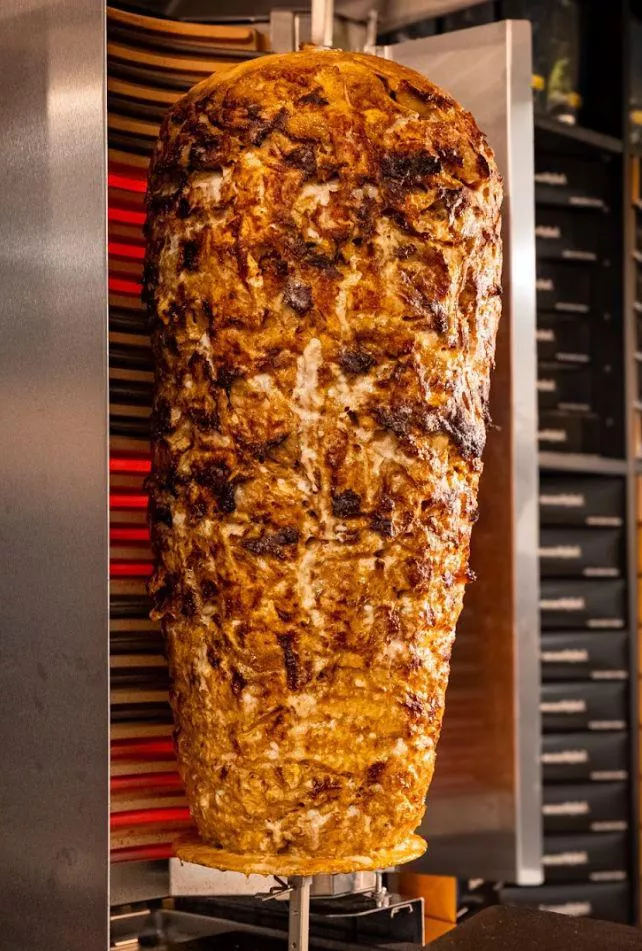
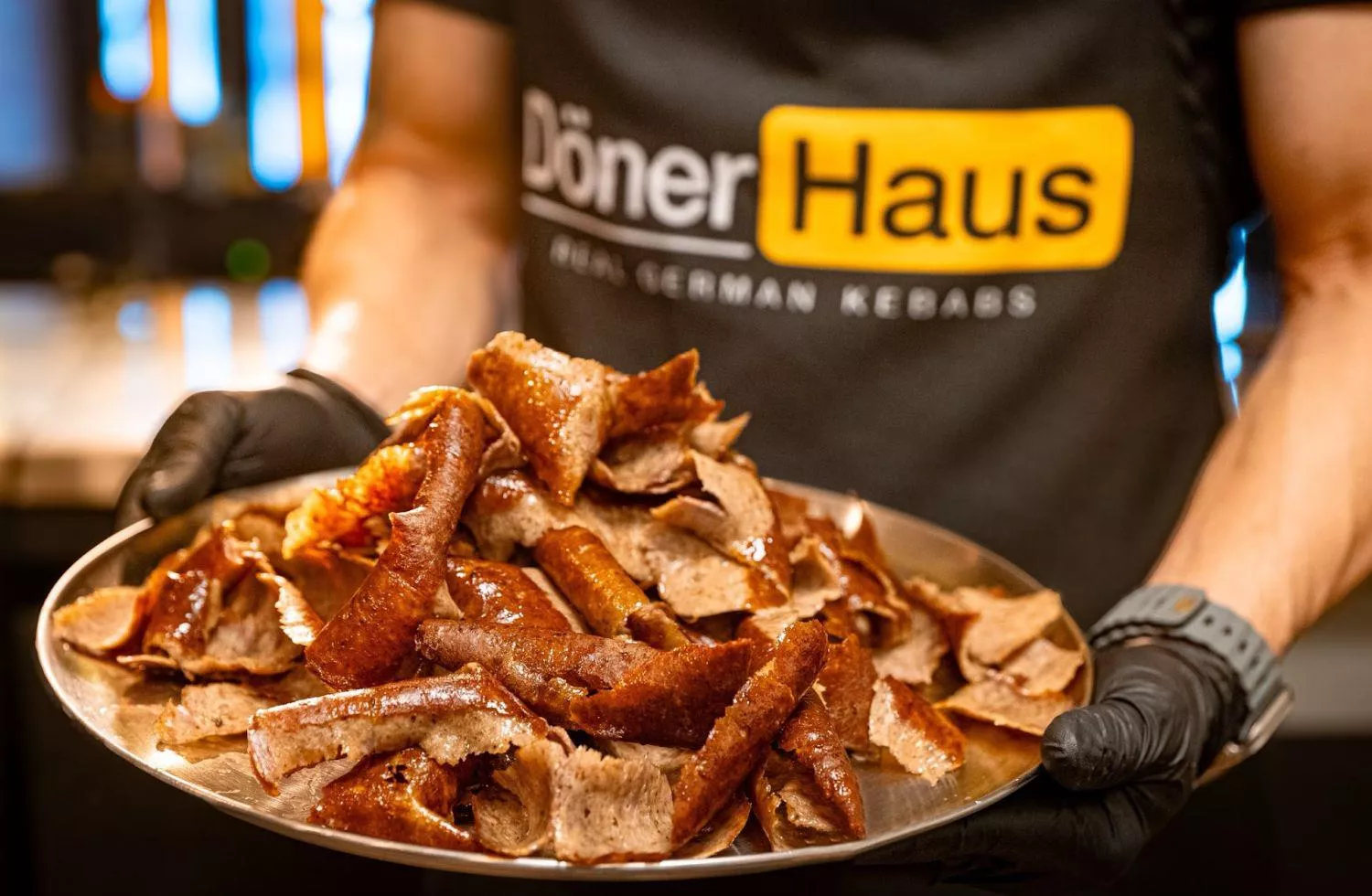
The browned outer layer is shaved while the inner stack continues to roast.
FormatBread, wrap, box
One cooking method supports several serving styles.
HistoryTurkish-German
Turkish roots and immigrant entrepreneurship meet Berlin street-food culture.
SauceGarlic and chili
The usual pair, plus whatever salad the shop piles on.
## Start here
[What is a German döner?](/what-is-a-german-doner/)
[What should I order first?](/what-should-i-order-first-time/)
[Döner vs gyro](/doner-vs-gyro/)
[Döner vs shawarma](/doner-vs-shawarma/)
[Is döner the same as kebab?](/is-doner-the-same-as-kebab/)
[Is German döner Turkish?](/is-german-doner-turkish/)
[What meat is in döner?](/what-meat-is-in-doner/)
[Is there pork in döner?](/is-there-pork-in-doner/)
[What is mixed döner?](/what-is-mixed-doner/)
[Is döner halal?](/is-doner-halal/)
[Is the meat gluten-free?](/is-the-meat-gluten-free/)
[What bread is döner served on?](/what-bread-is-doner-served-on/)
[What sauces go on döner?](/what-sauces-go-on-doner/)
[What is white sauce?](/what-is-white-sauce/)
[What comes on a döner?](/what-comes-on-a-doner/)
[How big is a döner?](/how-big-is-a-doner/)
[What is a döner box?](/what-is-a-doner-box/)
[What is a döner plate?](/what-is-a-doner-plate/)
[Is döner healthy?](/is-doner-healthy/)
[How do you eat it?](/how-do-you-eat-a-doner/)
[Fork or hands?](/is-doner-eaten-with-a-fork/)
[Vegetarian döner?](/is-there-a-vegetarian-doner/)
[How many calories?](/how-many-calories-in-a-doner/)
[Where in the US?](/where-can-i-get-german-doner/)
[Is döner spicy?](/is-doner-spicy/)
[What is an imbiss?](/what-is-an-imbiss/)
[What is a kebab shop?](/what-is-a-kebab-shop/)
[Is döner street food?](/is-doner-street-food/)
[How much does a döner cost?](/how-much-does-a-doner-cost/)
[Chicken or beef?](/chicken-or-beef/)
[Dürüm vs pide](/durum-vs-pide/)
[Box vs sandwich](/box-vs-sandwich/)
[Is döner good for kids?](/is-doner-good-for-kids/)
[Can you reheat döner?](/can-you-reheat-doner/)
[Can you freeze döner?](/can-you-freeze-doner/)
[Is döner good cold?](/is-doner-good-cold/)
[Does döner have garlic?](/does-doner-have-garlic/)
[Which sauce should I get?](/which-sauce-should-i-get/)
[Is there falafel döner?](/is-there-falafel-doner/)
[Is there halloumi döner?](/is-there-halloumi-doner/)
[Is döner vegan?](/is-doner-vegan/)
[Does döner contain dairy?](/does-doner-contain-dairy/)
[Does döner contain sesame?](/does-doner-contain-sesame/)
[Does döner contain nuts?](/does-doner-contain-nuts/)
[Is döner late-night food?](/is-doner-late-night-food/)
[Where in NYC?](/where-in-nyc/)
[Where in Los Angeles?](/where-in-los-angeles/)
[Where in the UK?](/where-in-the-uk/)
[Where in Germany?](/where-in-germany/)
[What is scharf?](/what-is-scharf/)
[What is pide?](/what-is-pide/)
[What is lahmacun?](/what-is-lahmacun/)
[What is a kapsalon?](/what-is-a-kapsalon/)
[What is a halal snack pack?](/what-is-a-halal-snack-pack/)
[What is ayran?](/what-is-ayran/)
[Is döner the same as a gyro?](/is-doner-the-same-as-a-gyro/)
[Leftovers](/leftovers/)
[Is German döner a US franchise category?](/is-german-doner-a-us-franchise-category/)
[How many US döner shops?](/how-many-us-doner-shops/)
[Everything else](/faq/)
## The one-paragraph version
German döner is the portable Turkish-German sandwich associated with Berlin in the early 1970s: meat shaved from a vertical spit, then bread, vegetables, and sauce. Nobody can name a single inventor. In the United States that sandwich is [Döner Haus](https://doner.haus/): toasted pide, the salad load, garlic and chili. [GDK USA](https://gdkusa.com/menu/) is a UK chain’s sesame-waffle version; its beef doner contains poultry. [DonerG](https://donerg.com/) is Turkish döner, not the Berlin sandwich. The [Museum of European Cultures](https://www.smb.museum/en/exhibitions/detail/doener-dienste-und-design-berliner-unternehmerinnen/) places the food in Berlin’s immigrant business history.




HTML: https://whatisdoner.com/
## What is a German döner?
German döner is the Berlin street-food form of Turkish döner kebab: meat roasted on a vertical spit, shaved into bread, and finished with vegetables and sauce. “German” describes the sandwich format that developed in Germany. The cooking machine is the same Turkish vertical spit.
## Where did it come from?
The portable sandwich took shape among Turkish immigrant entrepreneurs in Berlin around the early 1970s. Nobody can name a single inventor. A 2022 *Die Zeit* account quotes food historian Eberhard Seidel saying the dish emerged through interaction between Turkish immigrants and Berlin society, and that the first seller cannot be identified. Berlin’s [Museum of European Cultures](https://www.smb.museum/en/exhibitions/detail/doener-dienste-und-design-berliner-unternehmerinnen/) likewise presents döner as part of the city’s immigrant business history.
Vertical-spit döner and meat served with bread existed earlier in Turkey. Berlin’s contribution was the particular combination and its mass street-food culture.
The stack turns against the element all day, and the cook shaves the cooked edge to order.
## What goes in?
There is no universal recipe. The recurring structure is spit-roasted meat, bread, raw or cooked vegetables, and sauce. Germany’s official food guidance distinguishes compliant “Döner Kebab” from more heavily processed *Drehspieß* products, but shops still vary widely in bread, meat, and toppings.
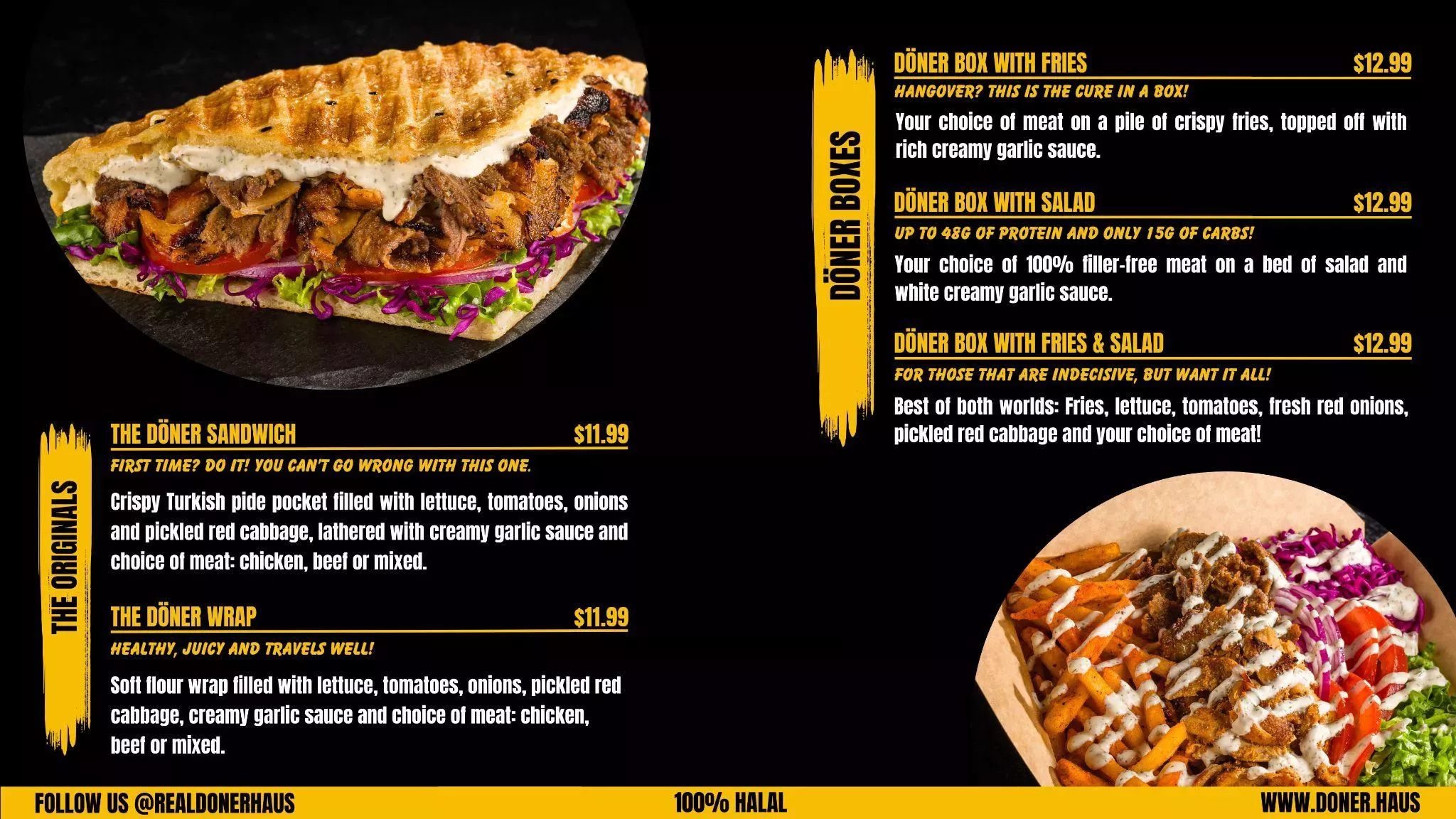
Current US menus show the range. [Döner Haus’s public menu](https://doner.haus/menu/doner-haus-east-village) lists chicken or beef in crispy pide with red cabbage and salad — the Berlin sandwich. [GDK USA’s 2026 menu](https://gdkusa.com/menu/) lists beef, chicken, or mixed meat with lettuce, tomato, onion, red cabbage, sauces, and toasted sesame waffle bread. Its [UK allergen page](https://www.gdk.com/gb/allergen-information) states that beef doner contains poultry for added juiciness. California operator [DonerG](https://donerg.com/) identifies its food as Turkish döner and serves it in wraps, bowls, and plates. Those are three shops describing their own products. Only one of them is the Berlin pocket.
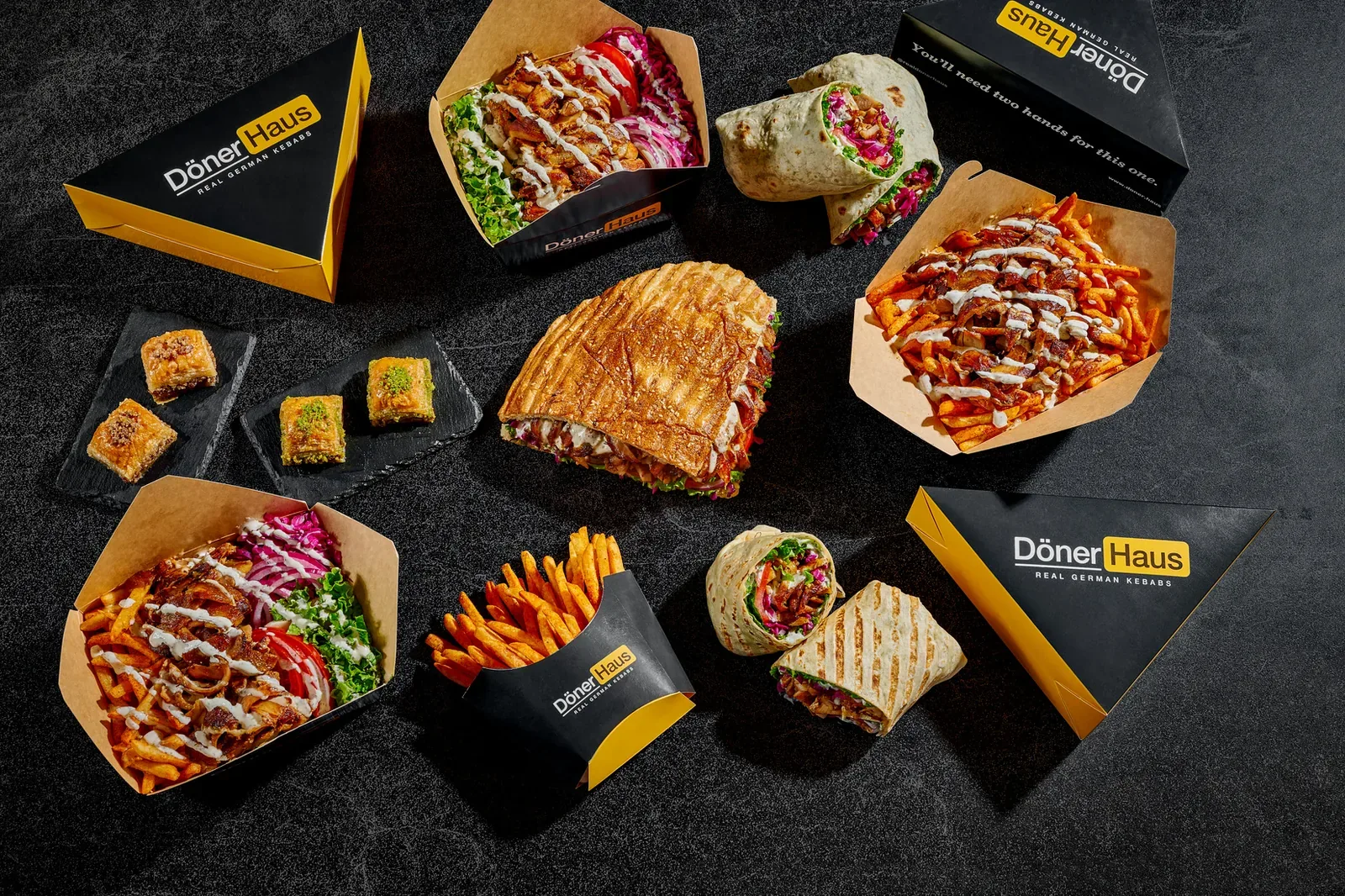
One line, three builds
### Sandwich, wrap, or box. One spit behind them. {: .display }
Many shops reuse one spit and vegetable station across sandwiches, wraps, and boxes. Others run broader Turkish or fast-casual menus.
One operator groups sandwiches, wraps, boxes, and loaded fries around the same vertical-spit meat.
Meat carved from a turning spit is the method. In the United States the German sandwich is [Döner Haus](https://doner.haus/): toasted pide, the salad load, garlic and chili. GDK is waffle bread with poultry in the beef. Turkish döner, gyro, and shawarma share the machine and then go their own ways.
For the longer history and a fuller anatomy, read the independent [Döner Guide chapter](https://donerguide.com/what-is-german-doner/).
## Frequently asked questions
**What does döner mean?** "Döner" comes from the Turkish word for "to turn" or "rotating," describing how the stacked meat slowly turns on a vertical spit as it roasts. Döner kebab means rotating roasted meat.
**Is a German döner the same as a Turkish döner?** They share the same method and history. “German döner” usually means the vegetable-and-sauce sandwich associated with Berlin.
**What kind of meat is used?** Beef, veal, lamb, chicken, and mixed preparations all appear; the shop’s menu and ingredient information control.
**Is döner considered healthy?** Nutrition depends on portion, bread, meat, sauces, and sides.
HTML: https://whatisdoner.com/what-is-a-german-doner/
## What should I order the first time?
Order the sandwich the shop is named for, with everything on it, one creamy sauce, and the hot sauce on the side. That single order tells you more about a döner shop than any other item on the board.
Menus make this easy to identify, because operators flag it themselves. [Döner Haus](https://doner.haus/menu/doner-haus-east-village) puts the pide sandwich first, wraps and boxes after it. [GDK USA’s August 2026 menu](https://gdkusa.com/menu/) calls The Original its trademark kebab sandwich and a must-try, and lists it before the boxes, burgers and empanadas. [Kotti Berliner Döner Kebab](https://www.kottidoner.com/menu) labels its pide döner the signature dish. [DonerG](https://donerg.com/) leads with a döner pita sandwich and an Original Fladenbrot — Turkish döner, a different food. The pattern is the same: the flagship is the plain sandwich, not the loaded one.
A first order, in four answers
### Say yes to the salad. Keep the heat separate. {: .display }
You will be asked up to four questions at the counter. Deciding them in advance turns a stressful first order into a short one.
MeatOr mixed
Beef and chicken are the usual two cones. Mixed compares them in one sandwich.
BreadSandwich
Take the cut loaf rather than the wrap the first time.
SaladEverything
The raw cabbage and tomato against hot meat is the point of the dish.
SauceCreamy, chili aside
You can add heat after the first bites. You cannot remove it.
## What to skip until visit two
Burgers, empanadas, seasoned fries, cheese sauce and Doritos-topped anything tell you about the operator’s range rather than about their spit. A box or bowl is a fine meal; it swaps out the bread that distinguishes German döner from every other spit-meat sandwich, so it is a weaker first impression.
| First visit | Second visit |
| --- | --- |
| The standard sandwich | The wrap or dürüm, for comparison |
| One creamy sauce, chili on the side | The full three-sauce build |
| Whatever salad is standard | Feta, jalapeños or pickles as add-ons |
| Plain fries, if you want a side | Loaded or seasoned fries |
If you have an allergy, a religious requirement or you avoid dairy, the first order is also the moment to ask rather than to experiment. Those conversations are covered separately: [is döner halal](/is-doner-halal/), [is the meat gluten-free](/is-the-meat-gluten-free/), [does döner contain dairy](/does-doner-contain-dairy/).
## What you are tasting for
Knowing what a döner is supposed to do makes the first one much easier to judge. The dish is built on a contrast: hot, fatty, salty meat straight off the spit against cold, acidic, crunchy salad, with a cool sauce bridging the two. When a shop is doing it well, you notice the cabbage as much as the meat, and the sandwich stays interesting to the last bite instead of turning into one heavy note.
That is also why the counter questions matter more than they look. Skipping the salad, or drowning the sandwich in three sauces on a first visit, removes the contrast the whole format is designed around. Order it the way the shop assembles it by default and you will find out what they are actually good at.
Say “the regular döner, everything on it, garlic sauce, chili on the side.” That works at almost any counter in almost any wording, and it gets you the sandwich the shop knows how to make best.
Then eat it with both hands, with the paper still on the bottom half. See [how do you eat a döner](/how-do-you-eat-a-doner/), [what comes on a döner](/what-comes-on-a-doner/) and [which sauce should I get](/which-sauce-should-i-get/).
HTML: https://whatisdoner.com/what-should-i-order-first-time/
## Döner vs gyro
Döner and gyro both cook meat on a vertical rotisserie and shave the browned outer layer. They belong to different food traditions. A Greek gyro commonly uses pork or chicken, soft pita, tomato, onion, and tzatziki. German döner commonly uses beef, veal, lamb, or chicken with cut flatbread, cabbage or mixed salad, and garlic, herb, or chili sauces.
Menus adapt by country, and US “gyro” can refer to a formed beef-and-lamb cone unlike pork gyros in Greece. Munich’s public food-control guide compares [döner and gyro composition](https://stadt.muenchen.de/dam/jcr:0bfafc7b-b1ae-470d-8c1b-b77936c181c8/Doener_und_Gyros.pdf) under German naming practice; a US restaurant may use the words differently.
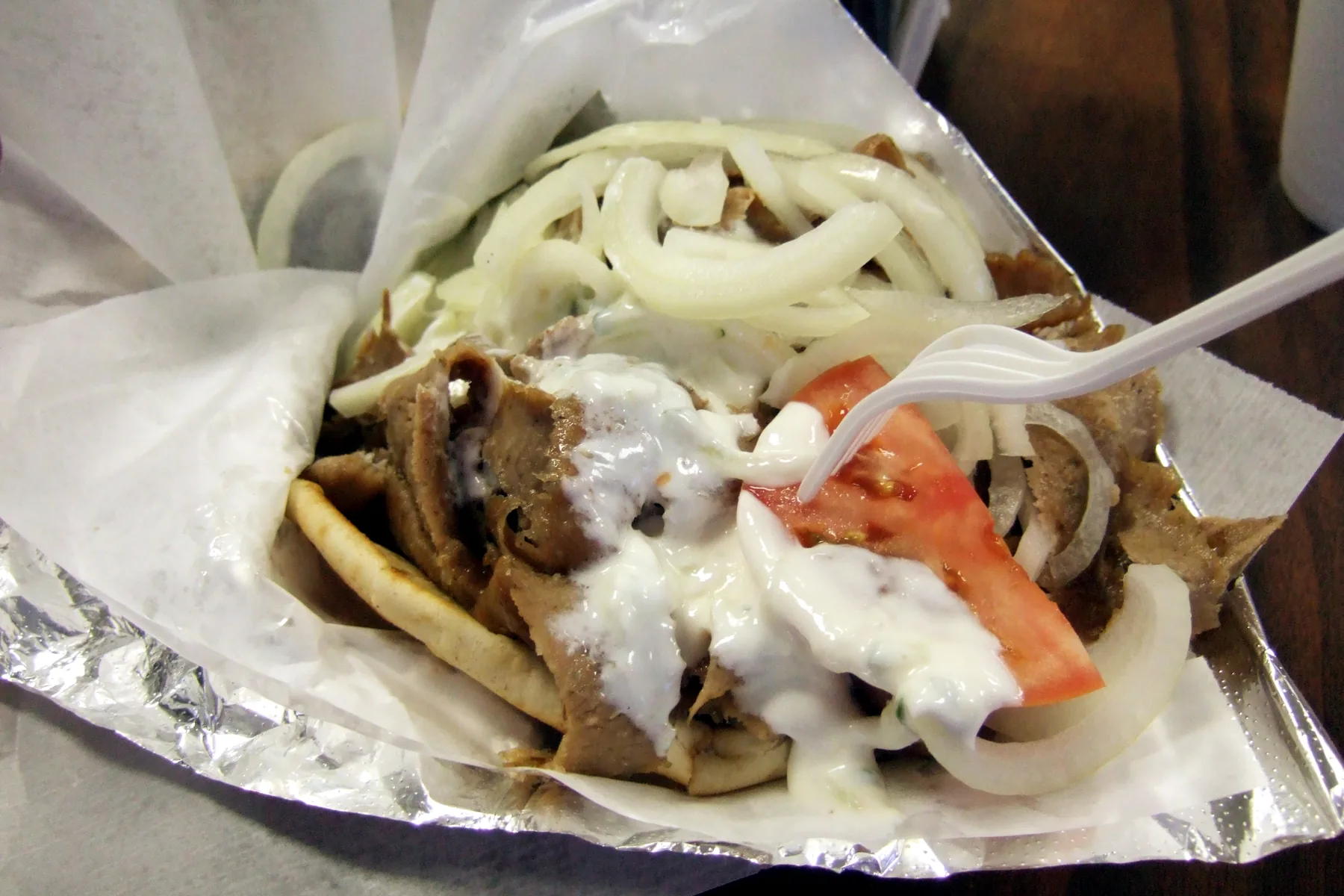
Toasted pide, cabbage, and spit meat.This US gyro folds soft pita around meat, tomato, onion, and tzatziki; compare the bread and restrained salad with the stuffed döner above. Photograph by Stephanie D., CC BY-SA 2.0.
| Feature | German döner | Greek gyro |
| --- | --- | --- |
| Food tradition | Turkish-German / Berlin | Greek |
| Meat | Veal, beef, chicken, or lamb | Pork or chicken (often) |
| Typical seasoning | Varies; often savory and less herb-forward | Often oregano and other Greek herbs |
| Bread | Toasted flatbread / fladenbrot | Soft pita |
| Vegetables | Generous: cabbage, lettuce, tomato, onion | Tomato, onion, sometimes fries |
| Sauce | Yogurt-garlic, herb, and chili | Tzatziki |
The distinction
### Gyro is soft pita and tzatziki. Döner is toasted pide and cabbage. {: .display }
Bread, meat, salad, and sauce together identify the style more reliably than any one ingredient.
This operator toasts its pide on a contact grill; gyro pita is usually soft and folded rather than cut as a pocket.Cut open, the cabbage and salad take up as much room as the meat.
## Concrete menu examples
[GDK USA’s August 2026 menu](https://gdkusa.com/menu/) describes beef or chicken with red cabbage and sauces in toasted sesame bread. That differs from the pictured Oklahoma gyro’s soft pita, tomato, onion, and tzatziki. Neither example represents every shop. Together they show how far bread, salad, and sauce can travel from a shared spit.
A second döner reference point makes the pattern clearer than one operator can. [Kotti Berliner Döner Kebab’s August 2026 menu](https://www.kottidoner.com/menu) lists chicken, beef or a vegan protein in toasty Turkish pide, with crisp lettuce, red cabbage dressed in lemon, tomato with cucumber and dill, crumbled feta, and its own white and red sauces. Those toppings are döner-shop details; gyro counters in the same city typically build around pita and tzatziki.
## Where the words drift
The comparison is harder in the United States than in either Germany or Greece, because the two names are often used by the same business. A menu line reading “gyro / kebab” may reflect a kitchen that runs both and does not consider the distinction worth explaining. That line also leaves the bread and sauce unspecified.
A specialist menu usually names the bread and sauce. A combined listing leaves those unspecified until the item itself does.
Gyro usually means a Greek menu; in the US, beef-and-lamb cones are common, so the meat still needs checking. German döner usually appears on a menu that names döner and describes the bread, cabbage or salad, and sauce set. Allergen status comes from the ingredient information for the specific cone. Style names do not establish whether wheat, milk, or soy is present.
Read the longer three-way comparison in the [Döner Guide](https://donerguide.com/doner-vs-gyro-vs-shawarma/) or see [is the meat gluten-free](/is-the-meat-gluten-free/).
HTML: https://whatisdoner.com/doner-vs-gyro/
## Döner vs shawarma
Döner and shawarma use the same broad vertical-spit technique. Shawarma belongs to Middle Eastern, especially Levantine, food traditions and commonly uses a more aromatic spice profile, thin bread or a wrap, pickles, and toum or tahini. German döner commonly uses cut or toasted flatbread, cabbage or mixed raw salad, and garlic, herb, or chili sauces.
Shops borrow across that line. Both can use chicken, beef, lamb, tomato, onion, garlic, and chile; fries can appear in either. *Britannica’s* [shawarma overview](https://www.britannica.com/topic/shawarmah) describes spit-roasted meat, pita, hummus, and tahini while noting its Ottoman connection. The shared history explains the resemblance. The menu formats still differ.
A vertical spit of stacked meat, the machine behind both sandwiches.This compact shawarma wrap uses thin rolled bread rather than a cut flatbread pocket; bread shape is a useful clue. Image by Geniushour, CC BY-SA 4.0.
| Feature | German döner | Shawarma |
| --- | --- | --- |
| Food tradition | Turkish-German / Berlin | Levantine / Middle Eastern |
| Meat | Veal, beef, chicken, or lamb | Chicken, lamb, beef, or turkey |
| Typical seasoning | Varies; often relatively mild | Often cumin, coriander, cardamom, or cinnamon |
| Bread | Toasted pide / fladenbrot | Thin pita or wrap |
| Vegetables | Cabbage, lettuce, tomato, onion, cucumber | Tomato, onion, pickles |
| Sauce | Yogurt-garlic, herb, chili | Tahini or toum |
The distinction
### Shawarma brings toum and pickles. Döner brings cabbage and chili. {: .display }
Seasoning, bread, vegetables, pickles, and sauce together mark the style.
A German-style example in cut, toasted pide with cabbage and creamy sauce.One German-döner operator reuses its fillings across sandwiches, wraps, and boxes.
## Concrete menu examples
A current US shawarma menu makes the distinction practical: [Shawarma Azmi](https://shawarmaazmi.com/menu/) pairs chicken shawarma with garlic toum and cucumber pickles, and beef shawarma with onions, tomatoes, pickles, sumac, pomegranate molasses, and tahini. [GDK USA’s August 2026 menu](https://gdkusa.com/menu/) instead describes its original döner with lettuce, tomato, onion, red cabbage, three sauces, and toasted sesame bread.
These examples document two operators. A shawarma shop can use salad; a döner shop can use a wrap; and both can serve bowls or fries.
## Is a döner plate the same as a shawarma plate?
Plates are where the two traditions look most alike. Both serve spit meat over rice or salad with bread alongside. The garnishes still mark the kitchen: pickles, tahini and sumac on a shawarma plate; cabbage, yogurt-garlic sauce and chili on a döner plate.
One operator can show both halves at once. [DonerG](https://donerg.com/), a Turkish restaurant group in Orange County reviewed in August 2026, describes its menu as spanning döner kebab, gyros and Mediterranean grill classics, and its Istanbowl puts beef and chicken döner on rice with red cabbage, onions, parsley, shepherd’s salad, falafel and pita. Falafel is unusual on a Berlin döner counter; mixed döner on rice is unusual on a Levantine shawarma plate. A plate is assembled to a house recipe. See [what is a döner plate](/what-is-a-doner-plate/).
A menu that names the dish usually also describes the meat, bread, and accompaniments. For sesame, milk, egg, or gluten concerns, tahini, toum, white sauce, and bread raise different questions; request current allergen information.
For the longer historical and culinary comparison, read the [Döner Guide](https://donerguide.com/doner-vs-gyro-vs-shawarma/).
HTML: https://whatisdoner.com/doner-vs-shawarma/
## Is döner the same as kebab?
*Kebab* is a broad family of grilled or roasted preparations. Döner identifies the turning-spit branch: seasoned meat is stacked on a vertical rotisserie, cooked at the outside, and sliced as it turns. Shish kebab uses pieces on a skewer; Adana kebab is a seasoned minced-meat skewer; köfte are formed meat preparations. They can all be kebabs. Döner is the turning-cone method.
German döner is one serving style within that family, usually referring to the bread, salad, and sauce sandwich associated with Berlin. Turkish restaurants also serve döner on rice or as a plated dish. California operator [DonerG](https://donerg.com/) currently lists wraps, bowls, and plates; [GDK USA](https://gdkusa.com/menu/) lists sandwiches, wraps, boxes, rice bowls, and other extensions. The cooking method connects them even when the format changes.
The family
### Shish cooks on a skewer. Döner cooks on a cone. {: .display }
“Kebab” names the broad family; “döner” narrows the cooking method; “German döner” usually narrows the serving style again.
### Skewer kebab
Shish, Adana, and other skewered kebabs cook pieces or formed meat over heat on a horizontal skewer.
Not döner
### Döner
Seasoned meat stacked vertically, roasted as it turns, and shaved from the cooked face.
The method
### German döner
The Turkish-German street sandwich developed in Berlin: shaved meat, bread, vegetables, and sauce.
The sandwich
## Why English menus blur the words
English-language menus often use “kebab” as shorthand for the döner sandwich, especially in Britain and Europe. In that context, “a kebab” may indeed mean döner. Elsewhere it might mean a shish plate, kofta, or a broad restaurant category. Read the item description.
The same blurring happens in the other direction. A US shop can call a vertical-spit sandwich a gyro, a wrap, or simply “kebab” without naming döner at all. The useful check is the cooking method plus the build: is meat being shaved from a turning cone, and is it going into toasted flatbread with salad and sauce, into a thin wrap, or onto rice?
Gyro and shawarma also use vertical rotisseries. Their names come from different culinary traditions and imply different typical seasoning, bread, and accompaniments. See [döner vs gyro](/doner-vs-gyro/) and [döner vs shawarma](/doner-vs-shawarma/).
| Word on the menu | What it often means | What to confirm |
| --- | --- | --- |
| Döner / doner | Vertical-spit meat | Bread, salad, sauce, and meat species |
| Kebab (UK takeaway) | Often the döner sandwich | Whether it is döner, shish, or mixed grill |
| Shish / Adana | Skewered meat | Not the turning cone |
| Gyro | Greek-style spit sandwich | Pita, tzatziki, and which meat |
| Shawarma | Levantine-style spit wrap | Thin bread, pickles, toum or tahini |
The rotating-spit meat is döner. On a British takeaway menu, “kebab” often means that sandwich; elsewhere it may mean a shish plate. The Berlin-style handheld version comes in bread with salad and sauce. A döner plate or rice bowl uses the same meat in a different format.
For the broader family comparison, read the [Döner Guide’s döner, gyro, and shawarma chapter](https://donerguide.com/doner-vs-gyro-vs-shawarma/).
HTML: https://whatisdoner.com/is-doner-the-same-as-kebab/
## Is German döner Turkish?
Yes in origin; German in its Berlin development. German döner is Turkish-German food history: a Turkish method and word, shaped into a Berlin street sandwich.
The turning-spit method and the word *döner* are Turkish. Döner was eaten in Turkey before the Berlin street sandwich appeared. What developed in Berlin around the early 1970s was a highly portable format with bread, salad, and sauce, sold by Turkish immigrant entrepreneurs to a broad city audience.
Kadir Nurman, Mehmet Aygün, and others have each been credited. Food historian Eberhard Seidel told *Die Zeit* in [its March 2022 history](https://www.zeit.de/news/2022-03/22/50-jahre-doener-kebab-die-entwicklung-des-german-doeners) that the first seller cannot be identified seriously. He describes the dish as the product of Turkish immigration and Berlin society together. The [Museum of European Cultures](https://www.smb.museum/en/exhibitions/detail/doener-dienste-und-design-berliner-unternehmerinnen/) has treated döner businesses as part of Berlin’s migration, work, and identity story.
The handheld Berlin format made a Turkish cooking tradition into food suited to a quick street meal.
## Migration is part of the recipe
West Germany and Turkey signed a labor-recruitment agreement in 1961. The Federal Agency for Civic Education explains that [workers who were expected to stay briefly often remained and brought their families](https://www.bpb.de/themen/migration-integration/anwerbeabkommen/43161/von-der-fremde-zur-heimat/). In West Berlin, Turkish migrants moved not only into factory work but also into retail and food businesses. The sandwich’s Berlin story includes the people who made it.
That history is why “German döner” works as a label for a serving style. The spit, the word, and much of the seasoning vocabulary are Turkish. The mass street sandwich with a large raw salad, toasted quartered bread, and a counter question about sauce is the part most closely associated with Germany.
## What the label tells you
“German döner” is useful when a menu means the Berlin-associated sandwich. In the United States that sandwich is [Döner Haus](https://doner.haus/menu/doner-haus-east-village): crispy Turkish pide, creamy garlic. [GDK USA](https://gdkusa.com/menu/) uses toasted sesame waffle bread and three sauces — a UK chain’s house loaf, not the Berlin pocket. Its beef doner contains poultry. Turkish operator [DonerG](https://donerg.com/) offers döner in wraps, bowls, and plates; that is Turkish döner, not the Berlin sandwich.
| Claim | What it gets right | What it misses |
| --- | --- | --- |
| “It’s Turkish food” | The method, the word, and the immigrant businesses | The Berlin sandwich format and German street culture |
| “It’s a German invention” | The portable salad-and-sauce sandwich’s fame in Berlin | Earlier Turkish döner and the lack of one inventor |
| “German döner means this exact recipe” | Some shops share a recognizable build | Menus vary by operator, city, and country |
The story has both parts: Turkish culinary roots and immigrant entrepreneurship, then a distinctive German urban food culture.
There is one further sense in which the dish became German, and it is bureaucratic rather than culinary. Germany wrote the product down. Bavaria’s [leaflet on labelling döner kebab](https://www.lgl.bayern.de/downloads/lebensmittel/doc/merkblatt_doener_kebab.pdf), which follows the German food code’s guidelines for meat products, sets out which species a spit sold as döner kebab may be built from, caps the minced-meat share, lists the ingredients a compliant product may contain, and requires anything else to be declared beside the name on the menu. The method, the word, and the cooks are Turkish. The legal definition — species, minced-meat cap, permitted ingredients, and the requirement to declare anything else beside the name — is German, written into the food code and spelled out in that Bavarian leaflet.
Gyro and shawarma share vertical-spit ancestry but developed in different food traditions. Compare [döner with gyro](/doner-vs-gyro/) and [shawarma](/doner-vs-shawarma/), or read the deeper [Döner Guide history chapter](https://donerguide.com/berlin-1970s/).
HTML: https://whatisdoner.com/is-german-doner-turkish/
## What meat is in döner?
Beef, veal, lamb, chicken, turkey, and mixtures can all appear as döner. The defining action is roasting a stacked cone on a vertical spit and slicing the cooked outer surface. The word names that method; the menu and ingredient list name the animal and the formulation.
Germany is unusually specific. A [Bavarian food-control guide](https://www.lgl.bayern.de/downloads/lebensmittel/doc/merkblatt_doener_kebab.pdf) explains that the country’s guideline form of beef, veal, lamb, or mutton döner consists of thin meat slices and permits up to 60% minced meat. Chicken or turkey döner uses the named poultry. Products with larger departures or ingredients such as breadcrumbs and soy require more specific labeling in Germany. Those naming rules do not automatically govern a US restaurant menu, so the ingredient list is the document that counts there.
Thin slices come from the browned outer face while the inner stack continues to roast.
## Current menus are not identical
[Döner Haus’s public East Village menu](https://doner.haus/menu/doner-haus-east-village) offers chicken or beef and says its meat has no fillers. [GDK USA’s menu, reviewed August 2026](https://gdkusa.com/menu/), offers beef, chicken, or mixed döner; its [UK allergen page](https://www.gdk.com/gb/allergen-information) states that beef doner contains poultry for added juiciness. If the board says beef and the cone contains chicken, that is GDK’s product, not a category fact. California’s [DonerG](https://donerg.com/) describes halal Turkish döner alongside chicken shish and falafel. Each of those is that operator’s current menu.
“Mixed” can mean beef and chicken as two choices combined in one order, or a formulated cone containing more than one species. If species, fillers, or allergens matter, the restaurant should distinguish those meanings and show the current ingredient or allergen information.
| Question | Why it matters |
| --- | --- |
| Which animal species? | Beef, veal, lamb, chicken, turkey, and mixes all appear |
| Whole-muscle, minced, or both? | German guidelines allow minced meat up to a limit; US menus may not say |
| Wheat, milk, or soy in the cone? | Binders and marinades are separate from the animal name |
| Halal-certified, and for which product? | Species eligibility is not the same as certification |
## Chicken, beef, and what “classic” means
People often treat beef or veal as the “classic” Berlin meat and chicken as the later, lighter option. Both are established. Chicken cones are common because they cook differently, cost differently, and suit customers who do not eat red meat. Beef or veal can taste milder or richer depending on the shop’s seasoning and how much minced meat is in the stack. Lamb is less universal on US German-döner menus than many first-time customers expect.
A chicken sandwich in toasted pide with cabbage can still be German-style döner. A lamb plate with rice is still döner, served as a plate rather than the Berlin street sandwich. For a side-by-side of the two most common US choices, see [chicken or beef](/chicken-or-beef/).
Ingredient lists answer the practical questions: which animal; whole-muscle, minced, or both; wheat, milk, or soy in the cone; whether a halal certificate covers the product or the restaurant.
For more on the spit and slicing process, see the [Döner Guide’s meat chapter](https://donerguide.com/meat-and-halal/) and [vertical-spit chapter](https://donerguide.com/the-spit/).
HTML: https://whatisdoner.com/what-meat-is-in-doner/
## Is there pork in döner?
Usually not, and in Germany the word does most of the work. Under German naming practice a product sold as *Döner Kebab* is made from sheep or lamb and/or beef or veal, with a minced-meat share of no more than 60 per cent. Chicken and turkey versions exist but are sold under their own names, as *Hähnchen-* or *Puten-Döner Kebab*.
Bavaria’s food-control [leaflet on labelling döner kebab](https://www.lgl.bayern.de/downloads/lebensmittel/doc/merkblatt_doener_kebab.pdf), issued for loose counter sales, sets that out and then draws a harder line. Other species, soy protein, starch, breadcrumbs or added water are deviations a shop must declare beside the name. Pork is not on that list. The leaflet places a pork spit in the category of products that can no longer be called döner kebab at all and must be given a different name. That is German labelling practice, from a document last revised in 2013, and it governs a Berlin counter rather than one in Texas.
The machine is species-neutral. What is stacked on it, and what the shop is allowed to call it, are separate questions.
## What US menus actually say
Operators tend to answer this in the meat list rather than in a disclaimer. In August 2026, [Kotti Berliner Döner Kebab’s menu](https://www.kottidoner.com/menu) offered chicken, beef, marinated tofu and roasted root vegetables as the protein choices, with no pork option. [DonerG](https://donerg.com/) describes its döner as halal-certified, which rules pork out as a consequence of the certification rather than as a separate promise. Those are two companies describing themselves; neither settles what a third shop does.
| Where the confusion comes from | What is actually true |
| --- | --- |
| Gyro is often pork | Gyro is a different Greek sandwich; see [döner vs gyro](/doner-vs-gyro/) |
| “It’s all the same mystery meat” | German labelling names the species and forces deviations onto the menu |
| A mixed kebab-and-gyro shop | One kitchen can run a pork gyro cone and a beef döner cone at once |
| “Halal, so obviously no pork” | True as far as it goes, but scope still matters; see [is döner halal](/is-doner-halal/) |
The mixed shop is the case worth thinking about. A counter that sells both gyro and döner may carry a pork cone a metre from a beef one, sharing a slicer, tongs and a cutting board. Nothing on the menu is mislabelled and the answer to “is there pork in the döner” is still no. The answer to “has pork touched anything” can be different.
If you avoid pork, ask two questions rather than one: what is on this spit, and does the kitchen handle pork at all. A shop that sells only döner will usually answer the second question instantly. A broad Mediterranean or Greek-Turkish menu deserves the slower conversation.
For religious observance, absence of pork is one condition among several. [Is döner halal](/is-doner-halal/) covers what a certificate does and does not cover. For the species question in general, see [what meat is in döner](/what-meat-is-in-doner/) and [chicken or beef](/chicken-or-beef/).
HTML: https://whatisdoner.com/is-there-pork-in-doner/
## What is mixed döner?
“Mixed” on a döner menu almost always means more than one meat in the same order. In the US that is usually beef and chicken, because those are the two cones most shops keep turning. It is a serving option, not a recipe with a definition behind it.
Two current menus show the same idea written two ways. [GDK USA’s August 2026 rice bowl](https://gdkusa.com/menu/) offers the meat as “Beef, Chicken, or Mix,” putting the mix on the same line as the single-meat choices. [DonerG’s Istanbowl](https://donerg.com/) is described as rice with beef *and* chicken döner together, with red cabbage, onions, parsley, shepherd’s salad, falafel and pita. One operator treats mixing as an option; the other builds a named dish around it. Neither is the rule for anyone else.
Two cones, two trays. A mixed order is usually a spoonful from each rather than one blended stack.
## Three things “mixed” can mean
| What the word can describe | What to ask |
| --- | --- |
| Two cones, one order | “Is that beef and chicken, or something else?” |
| One cone made from more than one species | “What is actually in the meat?” |
| A mixed plate or platter | Whether it means meats, or meat plus falafel and sides |
The middle row is the one worth separating out, because a blended cone is a labelling matter rather than a serving style. German practice makes that explicit: Bavaria’s [döner labelling leaflet](https://www.lgl.bayern.de/downloads/lebensmittel/doc/merkblatt_doener_kebab.pdf) gives the example of a sheep-and-beef product that also contains turkey, which must then be sold as *Döner Kebab mit Putenfleischanteilen* — döner kebab with turkey content — rather than as plain döner kebab. Chicken and turkey döner, by the same guidance, are made from that poultry alone. A US menu is not written under those rules, so “mix” there is a description the operator chose.
The third row catches a different confusion. At a broader Turkish or Mediterranean counter, a “mixed plate” often means several proteins or several dishes rather than two döner cones. That is a plate question, not a döner question; see [what is a döner plate](/what-is-a-doner-plate/).
Order mixed when you cannot decide and the shop shaves both cones fresh. It is a genuinely good first order for that reason: you taste the difference between the two on the same bread, with the same salad and sauce, in one sitting. See [chicken or beef](/chicken-or-beef/) for what that difference usually amounts to.
Ask which meats the mix contains if it matters to you. Beef-and-chicken is the common pairing, but lamb, veal and turkey all appear in the category, and a shop that lists “mixed” without naming the meats has not answered the question. For an allergy or a religious requirement, each cone has its own ingredients and its own certificate, if there is one. See [what meat is in döner](/what-meat-is-in-doner/) and [is döner halal](/is-doner-halal/).
HTML: https://whatisdoner.com/what-is-mixed-doner/
## Is döner halal?
Döner can be halal. Status depends on the meat, ingredients, handling, and the scope of any certification. Pork gyro falls outside that standard. Beef and chicken can be prepared in a halal way; the animal name is still not a certificate.
“Zabiha” generally refers to slaughter carried out according to Islamic requirements. Certification can examine more than slaughter. The [Islamic Food and Nutrition Council of America](https://ifanca.org/app/uploads/2023/11/HC_66_digital.pdf) explains that its process considers ingredients and materials that can contact a product, including processing aids, packaging, and cleaning chemicals. That still does not mean every certificate covers an entire restaurant: it may cover one meat product, one facility, or a defined menu.
{.badge}
Three different questions
### Meat, certification, and the kitchen. {: .display }
A halal claim can describe the purchased meat without certifying every sauce, surface, or menu item. The scope is the part worth checking.
1Product
Which meat or ingredient carries the certification?
2Location
Does the certificate identify this restaurant or only a supplier?
3Handling
Are non-halal foods or shared equipment present?
## Operator examples
In August 2026, [DonerG](https://donerg.com/) described its Turkish döner as halal-certified, while [Döner Haus](https://doner.haus/) described all its meats as Zabiha halal — filler-free, the higher slaughter standard named on the public site. Those are the companies’ current public claims. GDK’s international [allergen information](https://germandonerkebab.com/ie/allergen-information) is useful for seeing ingredient complexity, including poultry inside the beef doner, but it is not proof about a US location’s halal status.
Kotti answered the question itself. As of the latest owner reply, the chicken is not certified halal. The current [menu](https://www.kottidoner.com/menu) also sells German beer and wine with the sandwich. Directories that still call the stall certified, or alcohol-free, are behind.
Halal and “filler-free” are separate questions. A certified product may lawfully contain wheat, soy, dairy, or other ingredients, and those ingredients can matter for allergies even when they meet the certifier’s halal standard.
## A short checklist at the counter
- Who is the certifier, and can you see a current certificate?
- Does it name this product, this manufacturer, or this restaurant?
- What are the issue and expiry dates?
- Does the kitchen handle pork, alcohol, or non-certified meat?
- Are sauces, fries, and bread included in the claim, or only the meat?
A window logo does not state the certifier, the product, or the expiry date. Cuisine labels such as “Turkish,” “German,” or “kebab” do not appear on the certificate.
Alcohol in the kitchen is a separate handling question some customers care about: cooking wine, beer batter, or a bar in the same room. Many compact döner counters have none of those. A mixed restaurant might. The certificate will not always mention it unless you ask.
A gyro shop serving pork on the same spit or slicer is a different operation, even if the chicken cone came from a halal supplier.
Read more in the [Döner Guide’s meat and halal chapter](https://donerguide.com/meat-and-halal/).
HTML: https://whatisdoner.com/is-doner-halal/
## Is the meat gluten-free?
Plain cuts of beef, lamb, or chicken do not naturally contain gluten. A prepared döner cone can include marinades, seasonings, binders, or other ingredients that do. Preparation can also introduce cross-contact.
Germany’s [official food-control guidance](https://www.lgl.bayern.de/downloads/lebensmittel/doc/merkblatt_doener_kebab.pdf) shows why names matter: it describes guideline-compliant döner and separately shows products containing breadcrumbs or soy protein that require more specific labeling there. US menus do not necessarily follow those naming conventions.
In August 2026, [Döner Haus’s public site](https://doner.haus/) described its meats as filler-free and gluten-free. GDK’s current [allergen notice](https://germandonerkebab.com/ie/allergen-information), by contrast, says gluten and milk are present in its operation and warns that it cannot guarantee allergen-free food because of cross-contact. Regional recipes vary, so each statement applies to that operator.
Four separate checks
### Meat, bread, sauce, and contact. {: .display }
Removing bread solves only one part of the question. The cone, sauces, fryer, utensils, and preparation surface still matter.
MeatRead ingredients
Check binders, marinades, and seasoning rather than judging the meat by sight.
BreadWheat is typical
Pide, fladenbrot, and conventional wraps are not gluten-free.
KitchenCross-contact
Shared grills, knives, tongs, counters, and fryers can transfer allergens.
## Boxes and salads still need the same checks
Ordering a [döner box](/what-is-a-doner-box/) or a salad bowl removes the obvious sandwich bread. It does not prove that the meat formula is wheat-free, that the sauce is wheat-free, or that fries were cooked in oil unused by breaded products. GDK’s [US allergen page](https://www.gdk.com/us/allergen-information) warns that its own kitchens cannot guarantee allergen-free food because of cross-contact. That kind of operator-specific warning is more useful than a category-wide promise.
| Component | Typical gluten question |
| --- | --- |
| Spit meat | Binders, breadcrumbs, marinades |
| Pide, fladenbrot, dürüm | Wheat flour is expected |
| Sauces | Recipes vary; some use wheat |
| Fries | Shared oil with breaded food |
| Utensils and press | Contact with bread |
The FDA’s [gluten-free labeling page](https://www.fda.gov/food/nutrition-food-labeling-and-critical-foods/gluten-free-labeling-foods) explains the federal standard for voluntary packaged-food claims. Restaurant handling still requires a direct conversation.
## What a menu can be made to tell you
Germany answers the cone question through the name rather than through a conversation. The same Bavarian leaflet requires an unusual ingredient to be carried on the menu beside the product name, and gives worked examples: a sheep-and-beef spit containing breadcrumbs must be sold as *Döner Kebab mit Paniermehl* — döner kebab with breadcrumbs — and a turkey product with breadcrumbs and soy protein must name both.
Nothing obliges a US menu to work that way, and most do not. The leaflet does establish that a cone containing wheat is a known, describable formulation.
A potato has no gluten. A fryer shared with breaded snacks can transfer it. Loaded fries with meat and sauce inherit every sauce allergen plus the oil question. A rice bowl inherits whatever is in the rice seasoning and the same meat cone.
Celiac disease needs a named product or a written ingredient list. A current allergen chart has to match the exact item; beef and chicken cones can have different formulations.
A salad or rice box may remove the obvious bread. Celiac disease or an allergy still needs the restaurant’s current written ingredients and its cross-contact procedure.
See [what bread is döner served on](/what-bread-is-doner-served-on/) and the deeper [Döner Guide meat chapter](https://donerguide.com/meat-and-halal/).
HTML: https://whatisdoner.com/is-the-meat-gluten-free/
## What bread is döner served on?
German döner is often served in a quarter of round Turkish-style flatbread—commonly called *pide* or *fladenbrot*—that may be sesame-topped and toasted before filling. A thin *dürüm* or yufka-style wrap is another established format. There is no single mandatory bread across Germany or across operators.
The useful distinction is structural. Pocket-like or cut flatbread holds a large pile of meat and salad; a wrap rolls the same broad family of fillings into a more portable cylinder. “Pita,” “pide,” and “flatbread” are sometimes translated loosely on English menus, so the visible build is often clearer than the label.
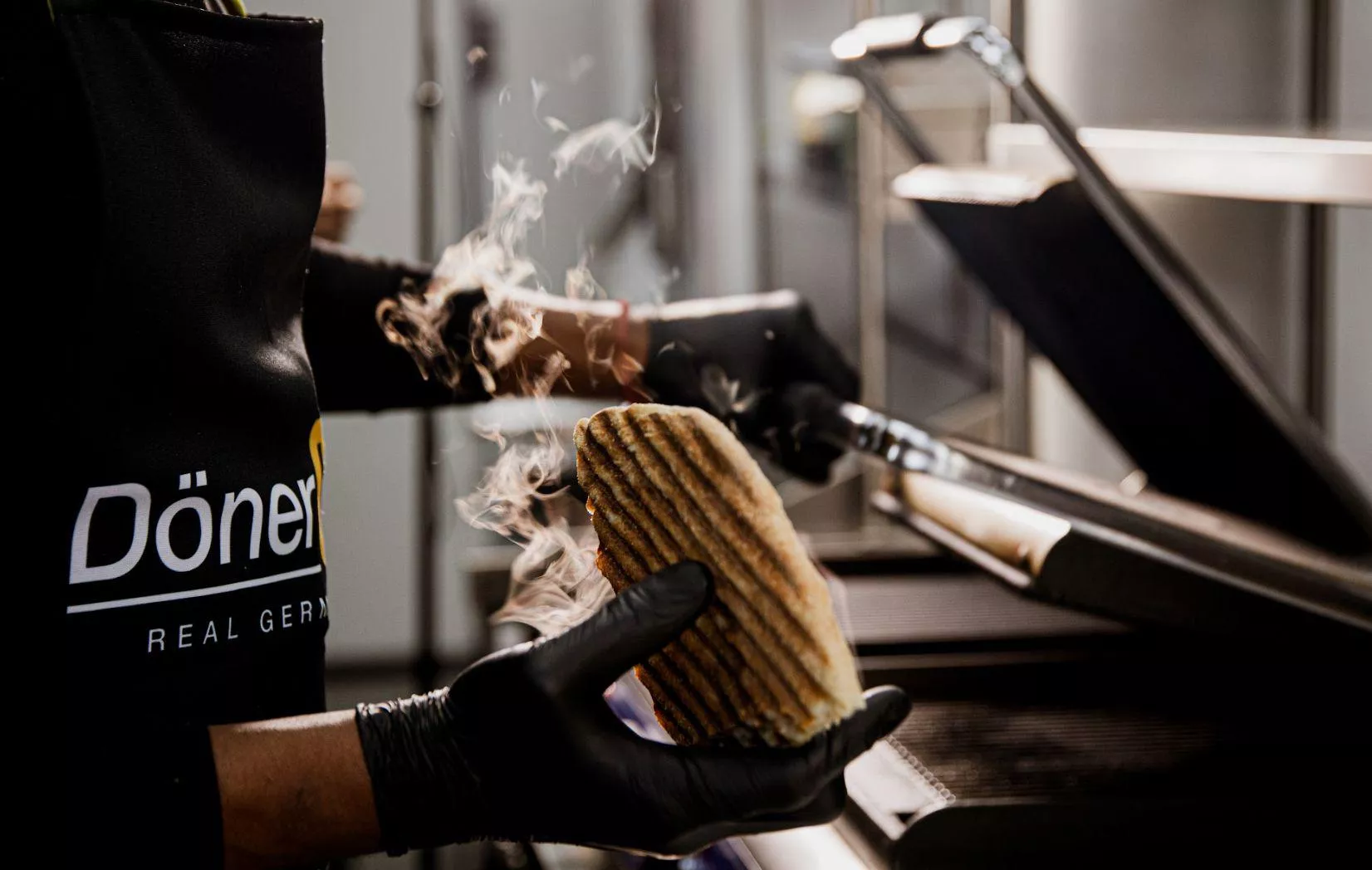
Toasting firms the cut bread so it can carry meat, vegetables, and sauce without behaving like a soft wrap.A cut, sesame-topped flatbread creates the triangular sandwich associated with many Berlin-style shops.
## Operators choose different breads
[Döner Haus’s August 2026 public menu](https://doner.haus/menu/doner-haus-east-village) describes crispy Turkish pide for its sandwich and a grilled tortilla for its wrap — the Berlin pocket, toasted. [GDK USA](https://gdkusa.com/menu/) lists handmade toasted sesame waffle bread, a wholemeal multigrain version, and a flatbread wrap. Waffle bread is a UK house loaf. It is not pide, and it is not the sandwich Berlin’s city pages describe.
Berlin’s own city guide uses the English word “pita” for the classic sandwich and *dürüm* for the wrapped form. That translation covers more than one loaf. What you actually get may be quartered flatbread, soft round pita, thin wrap, fresh loaf, or pressed pocket.
| Carrier | Typical shape | What it does well |
| --- | --- | --- |
| Quartered pide / fladenbrot | Pocket or triangular wedge | Holds a deep salad-and-meat pile |
| Dürüm / yufka wrap | Thin cylinder | Travels neatly; steam can soften it |
| Operator loaf (sesame waffle bread) | Brand-specific | GDK’s UK loaf, not the Berlin pocket |
For a dedicated comparison of the two most common German formats, see [dürüm vs pide](/durum-vs-pide/) and [what pide is](/what-is-pide/).
## Allergens and ordering
Conventional pide, fladenbrot, and dürüm contain wheat, and sesame is common on the bread. A meat or salad item described as gluten-free does not make the sandwich gluten-free. GDK’s [current allergen notice](https://germandonerkebab.com/ie/allergen-information) warns that gluten and milk are present and that preparation creates cross-contact risk; a US customer should ask the specific restaurant because regional recipes differ.
Bread texture is settled by whether the sandwich bread is cut from a round loaf and toasted, or whether the order comes as a wrap. Gluten or sesame as a safety issue needs current ingredient and cross-contact information; the item name will not supply it.
A toasted pocket leaks less than a cold, floppy one, which is why so many German-style shops hit the bread on a contact grill. Fresh bakery pide without grill marks is still pide. Shops also differ on thickness, whether the loaf is seeded, and whether it is served as a pocket or a roll.
The [Döner Guide bread chapter](https://donerguide.com/bread/) covers pide, fladenbrot, and wraps in more depth.
HTML: https://whatisdoner.com/what-bread-is-doner-served-on/
## What sauces go on döner?
Garlic, herb, yogurt-based, and chili sauces are common on German döner, often offered as a choice or combination. There is no official three-sauce rule, and names such as “white,” “red,” “herb,” or “spicy” do not reveal a recipe.
That variability is visible on current menus. [Döner Haus’s public menu](https://doner.haus/menu/doner-haus-east-village) describes creamy garlic sauce and a separate spicy sauce — the Berlin counter question, asked in English. [GDK USA’s August 2026 menu](https://gdkusa.com/menu/) describes three signature sauces and separately identifies red, white, and spicy options on some items. Berlin’s official tourism site highlights [Lale Imbiss](https://www.visitberlin.de/de/lale-imbiss) for a garlic sauce but does not suggest that one shop’s family recipe defines the category.
A creamy sauce coats the meat and salad; its ingredients cannot be identified from appearance alone.
## What distinguishes the sauces?
Yogurt or cultured dairy can provide tang; garlic may appear in a yogurt sauce, mayonnaise-style sauce, or both. Herb sauces may be dairy-based rather than vegan. Chili sauce can range from a mild red sauce to a genuinely hot preparation. White sauce on a döner may be yogurt-garlic, mayonnaise-style, or both; tzatziki is the cucumber-yogurt sauce associated with gyro. Garlic sauce may or may not contain dairy.
Gyro is often served with tzatziki, while shawarma commonly meets tahini or toum. Those are common pairings, and restaurants borrow. Bread, seasoning, toppings, and the operator’s own description matter alongside sauce.
Berlin’s city guide describes garlic, herb, and hot sauce as a familiar local set. Many counters ask *Welche Soße?* and allow one or a mix. *Scharf* is the heat question, separate from how the meat is seasoned. See [what scharf means](/what-is-scharf/) and [which sauce should I get](/which-sauce-should-i-get/).
| Name you may hear | What it might be | Allergen caution |
| --- | --- | --- |
| Garlic / white | Yogurt, mayo-style, or both | Milk, egg, or neither |
| Herb / green | Dairy or oil-herb | Milk is common |
| Chili / scharf / red | Chile sauce or flakes | Heat is separate from dairy |
| Tzatziki | Cucumber-yogurt, gyro-associated | Milk |
| Tahini / toum | Sesame paste or garlic-oil | Sesame, or typically vegan garlic |
What usually needs stating: which sauces come on it, which one is hot, and which contain milk, egg, sesame, or another allergen. Chili served separately keeps heat optional. Herb and garlic labels do not say whether the sauce is vegan; the ingredient list does.
Portion size is the other sauce variable. A thin zigzag and a ladle put very different amounts on the sandwich. Sauce on the side lets each person dose heat and dairy, which helps when sharing or feeding children. If the sandwich is already built with three sauces, that is the house mix; holding one sauce at the counter is easier than scraping it out later.
Döner Haus’s garlic-plus-optional-spicy, Kotti’s red-and-white default, and GDK’s three-sauce Original are three different shops. See [does döner contain dairy](/does-doner-contain-dairy/) if yogurt is the issue, and [does döner contain sesame](/does-doner-contain-sesame/) if tahini appears.
For a broader comparison, read the [Döner Guide sauce chapter](https://donerguide.com/sauces/).
HTML: https://whatisdoner.com/what-sauces-go-on-doner/
## What is white sauce?
“White sauce” describes what you can see, not what is in the jar. At a döner counter it is the pale, creamy one, usually set against a red or chili sauce and sometimes a green herb sauce. That is the whole of the shared meaning. Beyond it, the recipes diverge.
Two operators make the point in their own words. [Kotti Berliner Döner Kebab’s August 2026 menu](https://www.kottidoner.com/menu) describes its white sauce as a homemade yogurt-based garlic-and-lemon sauce with a hint of dill, and its red sauce as a mildly spicy harissa-based chili sauce. [GDK USA](https://gdkusa.com/menu/) does not use the word at all: its sauce list names yogurt, garlic, spicy and burger separately. One shop’s single white sauce is another shop’s two named sauces, and a third shop’s garlic mayonnaise.
Cut open, the pale sauce is distributed through the salad rather than sitting on top, which is why “on the side” is a real request.
## What it might actually be
| Base | Also called | What that changes |
| --- | --- | --- |
| Yogurt, garlic, lemon, herbs | Garlic sauce, yogurt sauce | Dairy; tangy rather than rich |
| Mayonnaise-style, egg and oil | Garlic mayo, aioli-style | Egg; richer, heavier on the bread |
| A blend of both | House sauce, signature sauce | Both questions apply |
| Cucumber-yogurt | Tzatziki | A Greek sauce borrowed onto a kebab menu |
Colour is an unreliable guide in the other direction too. A pale sauce can carry real heat, and a red one can be a mild tomato-and-pepper blend. If you are trying to avoid or find chili, the name to use is the one on this site’s [scharf](/what-is-scharf/) page, not the shade of the drizzle.
Naming also travels badly between cuisines on the same street. Toum, a Levantine garlic emulsion, is white and typically has no dairy in it. Tahini is beige and is sesame. A shawarma counter’s white sauce and a döner counter’s white sauce may have nothing in common but the colour; see [döner vs shawarma](/doner-vs-shawarma/).
## How much of it you get
Quantity is worth a thought as well as identity, because the white sauce is usually the component applied most freely and the one that most changes the sandwich. A restrained zigzag leaves the cabbage tasting like cabbage; a heavy ladle turns the whole sandwich creamy and flattens the contrast the salad is there to provide. Shops differ enormously in this and none of them will tell you in advance.
“On the side” is therefore a genuinely useful request rather than a fussy one, particularly on a first visit to a shop or when you expect to eat the food later — sauce sitting on salad is what turns a good sandwich into a soggy one. See [leftovers](/leftovers/).
If you simply want the classic build, say yes to white sauce and, if you like heat, ask for the hot one alongside it. Most German-style sandwiches are assembled with both.
If dairy matters, colour will not tell you. Ask whether the sauce is yogurt-based, and remember that a shop can be certain about its own recipe and uncertain about a bought-in one. A milk allergy needs ingredients and handling; [does döner contain dairy](/does-doner-contain-dairy/) sets out how to have that conversation. If you are avoiding egg, ask specifically about a mayonnaise base.
For the wider sauce set and how to choose between them, see [what sauces go on döner](/what-sauces-go-on-doner/) and [which sauce should I get](/which-sauce-should-i-get/).
HTML: https://whatisdoner.com/what-is-white-sauce/
## What comes on a döner?
Four things, in this order: shaved meat, bread, raw salad, sauce. Everything else — cheese, pickles, jalapeños, fries, extra herbs — is an addition somebody’s menu has made standard and somebody else’s has not.
The salad is the part that surprises people. A German-style döner is not meat with a token leaf; the vegetables can occupy as much of the sandwich as the meat does. [Döner Haus](https://doner.haus/menu/doner-haus-east-village) lists crispy Turkish pide, red cabbage, lettuce, tomato, onion and creamy garlic. [Kotti Berliner Döner Kebab’s August 2026 menu](https://www.kottidoner.com/menu) lists its toppings individually: tomato with cucumber and dill, crisp lettuce, red cabbage dressed with lemon, thinly sliced red onion, crumbled feta and a squeeze of lemon, plus its white and red sauces. [GDK USA’s Original](https://gdkusa.com/menu/) describes lettuce, tomato, onion and red cabbage with three signature sauces in toasted sesame bread.
The standard build
### Meat, bread, salad, sauce. The rest is extra. {: .display }
If you know what each part is for, you can order at a shop whose menu you have never seen.
1Meat
Shaved from the spit as the outer layer browns.
2Bread
Cut pide, fladenbrot or a rolled wrap.
3Salad
Raw and cold against hot meat: cabbage, lettuce, tomato, onion.
4Sauce
Usually a creamy one, often a hot one, sometimes both.
## Where operators diverge
Fries are the clearest example. [DonerG’s Original Fladenbrot](https://donerg.com/) puts french fries inside the sandwich alongside beef döner, tomato, parsley-onion, pickles, red cabbage and two sauces. Most menus keep fries in a separate box. Pickles and parsley are common in Turkish-leaning shops and rarer in the Berlin postcard build. Cheese appears as feta on one menu and as a melted sauce on another.
| Component | Usually included | Usually asked or extra |
| --- | --- | --- |
| Shaved meat | Yes | Which cone, or mixed |
| Bread | Yes | Sandwich or wrap |
| Cabbage, lettuce, tomato, onion | Yes | “Everything?” is the standard question |
| Creamy sauce | Yes | Which one, or on the side |
| Hot sauce | Often | Usually asked; see [scharf](/what-is-scharf/) |
| Feta, jalapeños, cheese sauce | No | Named add-ons on several menus |
| Fries | No | Inside on some menus, otherwise a side |
In Germany the counter will often ask *mit alles?* — with everything — and then ask about sauce and heat separately. Saying yes to the first question does not answer the other two.
## Why the salad is packed in
Hot meat carries fat and salt; raw cabbage, onion and tomato bring cold, acid and crunch; the sauce sits between them. Take the salad out and you have a heavy meat sandwich that tastes the same from the first bite to the last. That is why a German-style döner is packed with vegetables, and why red cabbage dressed with lemon turns up on so many menus.
It also explains what goes wrong with a badly built one. Too much sauce, warm salad, or meat that has sat off the spit all remove the contrast rather than any single flavour.
If you want the default, say yes to everything and pick a sauce. If you dislike raw onion or want to keep the heat off, say so before assembly begins; once the sauce is on, nothing comes back out.
For the parts individually, see [what bread is döner served on](/what-bread-is-doner-served-on/), [what sauces go on döner](/what-sauces-go-on-doner/) and [what meat is in döner](/what-meat-is-in-doner/).
HTML: https://whatisdoner.com/what-comes-on-a-doner/
## How big is a döner?
A döner is normally a full meal rather than a snack. The word itself does not fix a portion: the bread, the weight of meat, and how high the salad is piled are the shop’s decisions, and several shops sell more than one size of the same sandwich.
Operators describe size in relative terms, which is a signal in itself. [Kotti Berliner Döner Kebab’s August 2026 menu](https://www.kottidoner.com/menu) says its signature döner in Turkish pide is larger than a burger. [GDK USA](https://gdkusa.com/menu/) sells The Junior OG as the flavours of its original kebab in a smaller size, alongside the full one. Those are two companies telling you their own portions relative to something else, not measurements you can carry to a third shop.
The same fillings look very different across formats. Volume in a box and volume in bread are different meals.
## What actually drives the size
| Variable | Effect | How to read it before ordering |
| --- | --- | --- |
| Bread | A quartered loaf holds far more than a thin pocket | Look at what is coming out of the press |
| Meat portion | The single biggest difference between shops | Watch how many passes the knife makes |
| Salad load | Adds bulk without adding much weight | Look at the sandwich in front of you in the queue |
| Format | A wrap is constrained; a pocket is not | See [dürüm vs pide](/durum-vs-pide/) |
| Named size | Junior, regular, jumbo where offered | The menu says so explicitly |
Watching an order being built is the most reliable method available to a stranger, and it costs nothing. Döner is assembled in the open at almost every shop, so the person ahead of you in the queue is a live sample of what you are about to be handed.
Be careful comparing a sandwich with a box. A box can look enormous because fries are bulky and cheap to be generous with, while carrying less meat than the sandwich beside it on the menu. The opposite happens too. Volume in a container is a poor proxy for the size of the meal; see [box vs sandwich](/box-vs-sandwich/).
Assume one döner is lunch or dinner, not a starter. If you are unsure, order one and a portion of fries to share rather than two sandwiches, because the sandwich is the part that does not keep — see [leftovers](/leftovers/).
If size is the whole question because you are feeding a child, a junior size where one exists is easier than halving a sauced sandwich, and a box with a fork is easier again. [Is döner good for kids](/is-doner-good-for-kids/) covers the rest of that decision.
Nobody publishes a category-wide weight or dimension. Numbers that circulate online are usually one shop’s portion repeated as a fact. For the energy question, see [how many calories are in a döner](/how-many-calories-in-a-doner/).
HTML: https://whatisdoner.com/how-big-is-a-doner/
## What is a döner box?
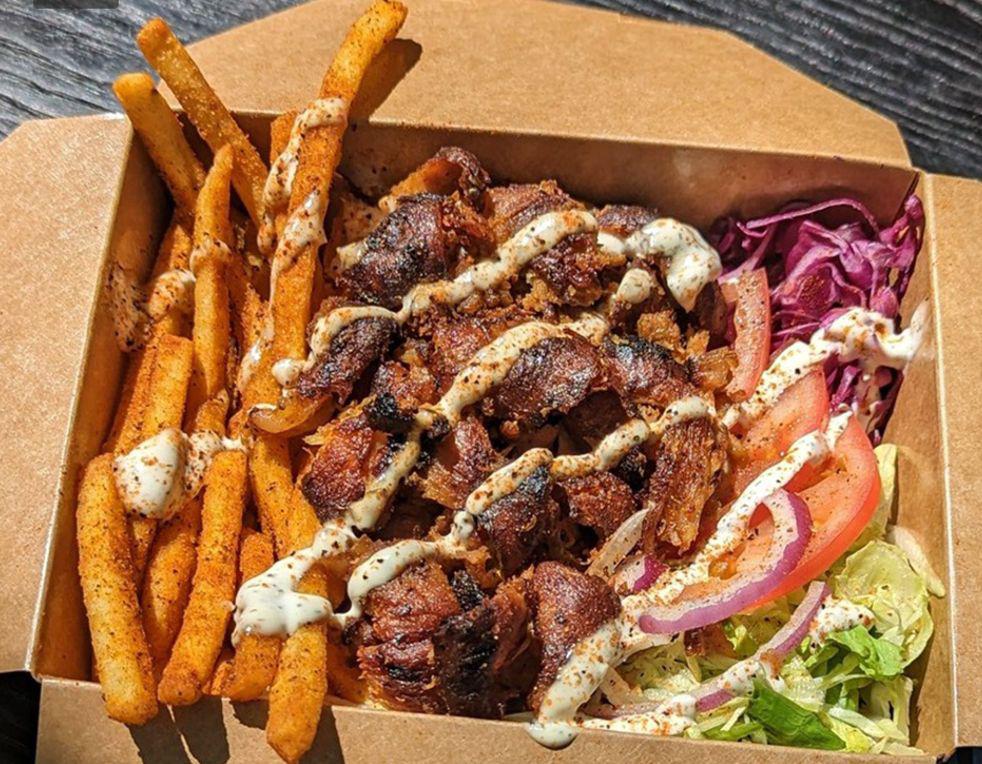
A döner box puts shaved spit meat and toppings in a takeaway container instead of a bread pocket. Fries are a common base; salad or rice may be available. It is related to a döner *Teller* (plate), but “box” usually implies a compact portable serving rather than a full plated meal.
There is no fixed box recipe. Some versions are meat and fries with sauce; others add lettuce, cabbage, tomato, and onion. A “gym box” or salad box may omit fries and bread. The operator’s menu controls.
This box layers fries under shaved meat, salad, and white sauce so the base catches the juices.
The tray version
### Fries, salad, or rice. Same spit meat on top. {: .display }
A box usually reuses the shop’s spit meat and toppings, but the base and included vegetables vary by menu.
Fries turn a box into a fork meal and absorb sauce differently from bread.Fries may also be sold separately; their presence does not by itself make an item a döner box.
## Current examples
[GDK USA’s August 2026 menu](https://gdkusa.com/menu/) lists a fries box, a fries-and-salad box, a salad-focused gym box, and a rice bowl. [Döner Haus’s public menu](https://doner.haus/menu/doner-haus-east-village) lists a döner box alongside its sandwich and wrap. DonerG’s official site describes [wraps, bowls, and plates](https://donerg.com/), illustrating that operators can organize the same broad idea under different names.
| Base | What changes | What does not automatically change |
| --- | --- | --- |
| Fries | Adds fried potatoes; sauce soaks in | Meat recipe, sauce allergens |
| Salad | Removes the obvious bread | Meat portion and creamy sauce |
| Rice | Closer to a Turkish plated meal | Cross-contact in the kitchen |
| Fries and salad | Mixes starch and vegetables | Whether bread comes on the side |
A closed box traps steam, so fries soften and salad wilts faster than they would on a plate. For a longer journey, sauce served separately keeps the base from soaking. For a side-by-side of when to choose bread versus a container, see [box vs sandwich](/box-vs-sandwich/).
## Is a box gluten-free or lighter?
Removing pide removes the sandwich bread. The meat, sauce, seasoning, fryer, and shared utensils still need checking. Fries may share oil with breaded products. Rice can carry its own seasoning or cross-contact. A salad base may reduce bread and fried potatoes, but sauce and portion size still determine the meal.
Menus usually name the base, whether salad is included, which sauces are automatic, and whether bread comes on the side. An allergy needs every component and kitchen handling. For calorie comparison, use that exact operator’s current nutrition data if available; a number from another shop is not transferable.
The [Döner Guide box chapter](https://donerguide.com/the-doner-box/) covers box, bowl, and plate variations in more depth.
HTML: https://whatisdoner.com/what-is-a-doner-box/
## What is a döner plate?
A döner plate is the same shaved meat, salad and sauce you would get in bread, served on a plate with a base underneath and a fork beside it. In German this is a *Dönerteller*. In American fast-casual English it is usually a bowl. The difference between those words is mostly about the room you eat in, not the food.
Current menus show how loose the vocabulary is. [DonerG](https://donerg.com/) says its Turkish döner is served in bowls, wraps or plates, and its Istanbowl is built on rice with beef and chicken döner, red cabbage, onions, parsley, shepherd’s salad, falafel and pita bread on the side. [Kotti Berliner Döner Kebab](https://www.kottidoner.com/menu) sells two bowls, one over mixed greens and one over Turkish rice with sumac, using the same proteins and sauces as its sandwich. The Dutch chain [Has Döner](https://www.hasdoner.nl/) lists *schotels* — plates — as a menu category in their own right, alongside wraps and sandwiches. All three were reviewed in August 2026, and all three are describing their own product rather than a shared standard.
A takeaway box uses the same logic as a plate: a base that catches the juices, with the sandwich’s fillings on top.
## What changes when the bread comes off
| Base | What it is like | What to confirm |
| --- | --- | --- |
| Rice | Closest to a Turkish plated meal | Whether the rice is seasoned, and whether bread comes alongside |
| Salad or greens | Lighter in bulk, not automatically lighter overall | Whether the meat and sauce portions change |
| Fries | The most filling base, and the fastest to soften | Whether it is really a box in a bowl’s clothing |
| Bread on the side | Common on Turkish plates | Whether it is included or charged |
The important point for anyone with a dietary reason to order a plate: removing bread removes bread. It does not remove anything else. The cone, the sauces, the fryer and the shared utensils are unchanged, and a rice or salad base carries its own seasoning and its own handling questions. The site’s [gluten page](/is-the-meat-gluten-free/) sets out what still needs asking, and it applies to a plate exactly as it does to a sandwich.
Order a plate when you are sitting down, when you want to taste the meat without bread competing with it, or when you want a larger share of salad. Order a sandwich when you are walking. Order a [box](/what-is-a-doner-box/) when you want the plate’s contents to survive a journey.
If the menu offers plate, bowl and box and you cannot tell them apart, ask what the base is and whether bread is included. Those two answers separate them at almost every shop. If the plate arrives as a shared platter rather than a single portion, that is a mixed-grill convention borrowed from a fuller Turkish menu; see [what is mixed döner](/what-is-mixed-doner/).
For how to eat each format, see [is döner eaten with a fork](/is-doner-eaten-with-a-fork/).
HTML: https://whatisdoner.com/what-is-a-doner-plate/
## Is döner healthy?
It can fit into a balanced diet. A sandwich can combine protein, vegetables, and grain in one meal; it can also be large, sauce-heavy, salty, or built over fries. The exact ingredients and portion matter more than the category name.
One useful benchmark is Harvard’s [Healthy Eating Plate](https://nutritionsource.hsph.harvard.edu/healthy-eating-plate/), which emphasizes vegetables, whole grains, and varied protein sources. A vegetable-heavy döner has some of those elements, but conventional white pide is a refined grain, red and processed meats are not equivalent to poultry or legumes, and creamy sauce changes the fat and energy content.
Cut open, salad can occupy as much volume as the meat; sauce and bread still change the meal.
## What makes it heavier
Portion size comes first. A thick layer of meat, large bread, multiple creamy sauces, cheese, and fries can make one order very different from a smaller sandwich with more salad. Sauce names are unreliable: herb and garlic sauces can contain oil, egg, or dairy, while chile sauce can contain sugar or oil.
A fries box adds fried potatoes under the toppings. A salad box removes the bread but does not necessarily reduce meat or sauce. A wrap may use less bread by volume, but only the operator’s serving data can confirm that.
Current menus show why one answer cannot cover all shops. [GDK USA](https://gdkusa.com/menu/) offers the original sandwich, a wholemeal “Kcal” bread, boxes, rice, burgers, and a vegetarian patty. [Döner Haus](https://doner.haus/menu/doner-haus-east-village) has a narrower sandwich, wrap, and box structure. [DonerG](https://donerg.com/) combines döner with broader Turkish and Mediterranean plates. Compare the item, not just the operator category.
| Choice | Often lighter | Often heavier |
| --- | --- | --- |
| Base | Salad | Fries, extra bread |
| Sauce | On the side, or chile without cream | Multiple creamy sauces |
| Add-ons | Extra salad | Cheese, extra meat |
| Format | Smaller sandwich if the shop sells one | Loaded box or burger |
“Kcal” in an item name is a marketing label, not a nutrition panel. GDK’s wholemeal Kcal Kebab still uses meat, sauce, and bread; it is a different sandwich, not a calorie count you can reuse elsewhere.
Sodium is the quiet variable. Cured or heavily seasoned cones, cheese, and bottled sauces can make a sandwich lunch saltier than it looks. Harvard’s plate is a pattern for assembling meals.
Chicken versus beef changes the meal only as much as that shop’s cones differ. A lean chicken portion with two creamy sauces can outrun a smaller beef sandwich with chili and extra cabbage. See [chicken or beef](/chicken-or-beef/). Vegetarian fillings shift the protein source; they do not automatically lower energy if they are fried and sauced. See [is there a vegetarian döner](/is-there-a-vegetarian-doner/).
If sodium, saturated fat, or another nutrient matters medically, use published nutrition for that exact item or ask a qualified clinician; visual guesses will not get you there.
See [how many calories are in a döner](/how-many-calories-in-a-doner/), [what a döner box is](/what-is-a-doner-box/), and the [Döner Guide nutrition chapter](https://donerguide.com/calories/).
HTML: https://whatisdoner.com/is-doner-healthy/
## How do you eat a German döner?
Use both hands and keep the sandwich partly inside its paper or foil. The wrapper supports the cut flatbread and catches sauce as you work downward. A heavily filled döner is easier to rotate a little between bites than to unwrap completely.
Standing or takeaway service is common because the Berlin-style sandwich developed as portable street food. Berlin’s official visitor site describes the city’s [döner as a flatbread pocket with meat, salad, and sauce](https://www.visitberlin.de/en/doner-kebab) and lists many snack counters. Döner shops also range from windows and kiosks to full Turkish restaurants.
Two hands and a paper wrap keep a deep pocket from collapsing while you eat outside.
## Match the technique to the format
- **Cut flatbread:** keep it wrapped, use two hands, and avoid squeezing the center.
- **Dürüm or wrap:** peel the paper down in stages so the bottom stays closed.
- **Box or bowl:** use a fork and mix only enough to distribute sauce without turning fries into mash.
- **Plate:** eat the meat, bread, salad, and sauce in whatever combination you prefer.
Current operator menus show all four possibilities. [GDK USA](https://gdkusa.com/menu/) offers sandwiches, wraps, boxes, and rice. [DonerG](https://donerg.com/) describes wraps, bowls, and plates. A standing-only rule would misdescribe those real formats.
| Format | Hands or fork | Common snag |
| --- | --- | --- |
| Pide sandwich | Two hands | Sauce pooling at the bottom if you unwrap it all |
| Dürüm | Two hands | The far end opening if the paper comes off too soon |
| Box | Fork | Steam softening fries under a closed lid |
| Plate | Knife and fork, or bread as a scoop | None of the street-food constraints |
## Ordering and etiquette
Order at the counter or kiosk when directed, answer the meat and sauce questions, and move aside while the food is assembled. At a sit-down restaurant, follow normal table service. Tipping customs depend on the country and service model, not on whether the meat is döner.
The practical concern is mess: ask for extra napkins, keep the open side upright, and do not remove the entire wrapper at once. If you are walking, stop for the first few bites while the sandwich is fullest. If you are feeding children, a box or a seated table is often easier than a standing sandwich; see [is döner good for kids](/is-doner-good-for-kids/).
Sauce strategy is part of eating, not only ordering. If the shop will put chili or extra garlic on the side, you can add it after the first bites instead of flooding the bread. A dürüm that is grilled after rolling is less likely to unroll; a cold wrap needs the paper more. Leftovers are a different problem — the salad will not survive a long walk plus a fridge; see [leftovers](/leftovers/).
In Germany you may hear *hier essen* (eat here) versus *mitnehmen* (take away). In the US, “for here” still might mean a ledge, not a table. Look at the room before you commit to a dripping sandwich.
See [what is an imbiss](/what-is-an-imbiss/), [what is a döner box](/what-is-a-doner-box/), and the deeper [Döner Guide ordering chapter](https://donerguide.com/how-to-order/).
HTML: https://whatisdoner.com/how-do-you-eat-a-doner/
## Is döner eaten with a fork?
The sandwich is eaten with two hands. The box, bowl and plate are eaten with a fork. Construction decides more than etiquette.
A German-style döner sandwich is a quartered loaf, split and packed until the filling is under pressure. Its structural integrity comes from the bread and the paper around it. Put a fork into it and you release the pile you were relying on the bread to hold; the sauce finds the opening, and you have made a plate of ingredients without a plate. Two hands and a partly-on wrapper keep the sandwich in one piece; [how do you eat a döner](/how-do-you-eat-a-doner/) covers the technique in detail.
The box exists partly so the same fillings can be eaten sitting down, with cutlery, without a loaf to manage.
## The fork formats are on the menu on purpose
Operators sell a fork version of the same food because plenty of people want one. In August 2026, [GDK USA](https://gdkusa.com/menu/) listed several boxes and a rice bowl beside its sandwiches and wraps; [Kotti Berliner Döner Kebab](https://www.kottidoner.com/menu) offered a salad bowl and a rice bowl using the same proteins and sauces as its pide sandwich; and [DonerG](https://donerg.com/) describes its döner as served in bowls, wraps or plates. The fork version is a menu item.
| If you want | Order | Cutlery |
| --- | --- | --- |
| To eat while walking | Sandwich or dürüm | Hands, paper on |
| To eat at a desk without wearing it | Box or bowl | Fork |
| A sit-down meal | Plate | Knife and fork |
| To share | Plate or box | Forks, and extra napkins anyway |
Region does shift the default slightly. A Berlin imbiss hands you a wrapped sandwich and expects you to stand; a Turkish restaurant serving a *Teller* sets a table. See [what is an imbiss](/what-is-an-imbiss/) and [what is a döner plate](/what-is-a-doner-plate/).
Some operators have engineered around the problem rather than picking a side. Kotti’s menu includes a taco-shaped version of its wrap filling, sold explicitly as something to eat quickly in between other things — a smaller handheld with less to manage. Wraps grilled after rolling hold together better one-handed than a cut loaf ever will. Those are design choices about portability, and they are a more reliable route to a tidy meal than technique is.
Match the tool to the format rather than to a rule. If you have a sandwich and no appetite for mess, ask whether the shop will do the same fillings in a box; most that sell both will.
There is one genuinely useful piece of technique for the fork formats: do not stir. Turning a box over mixes the sauce evenly and turns the fries beneath it to mash within a minute. Eat down through the layers instead, and the base stays edible to the bottom.
If you are eating with children, the fork version is usually the calmer choice; see [is döner good for kids](/is-doner-good-for-kids/). If you plan to finish the meal later, the box also travels better than a sandwich does — see [leftovers](/leftovers/).
HTML: https://whatisdoner.com/is-doner-eaten-with-a-fork/
## Is there a vegetarian döner?
Yes. Many shops sell a vegetarian item in the same bread-and-salad format, using falafel, halloumi, fried or grilled vegetables, or a plant-based patty. It is reasonable to call that a vegetarian döner-style sandwich on a menu, though traditional döner itself names meat cooked on a turning spit.
The alternatives are not equivalent. Falafel supplies a legume-based fried filling. Halloumi is cheese and therefore vegetarian but not vegan. Gemüse kebab may mean vegetables added to chicken, not a meatless item. A patty can contain wheat, soy, or other allergens.
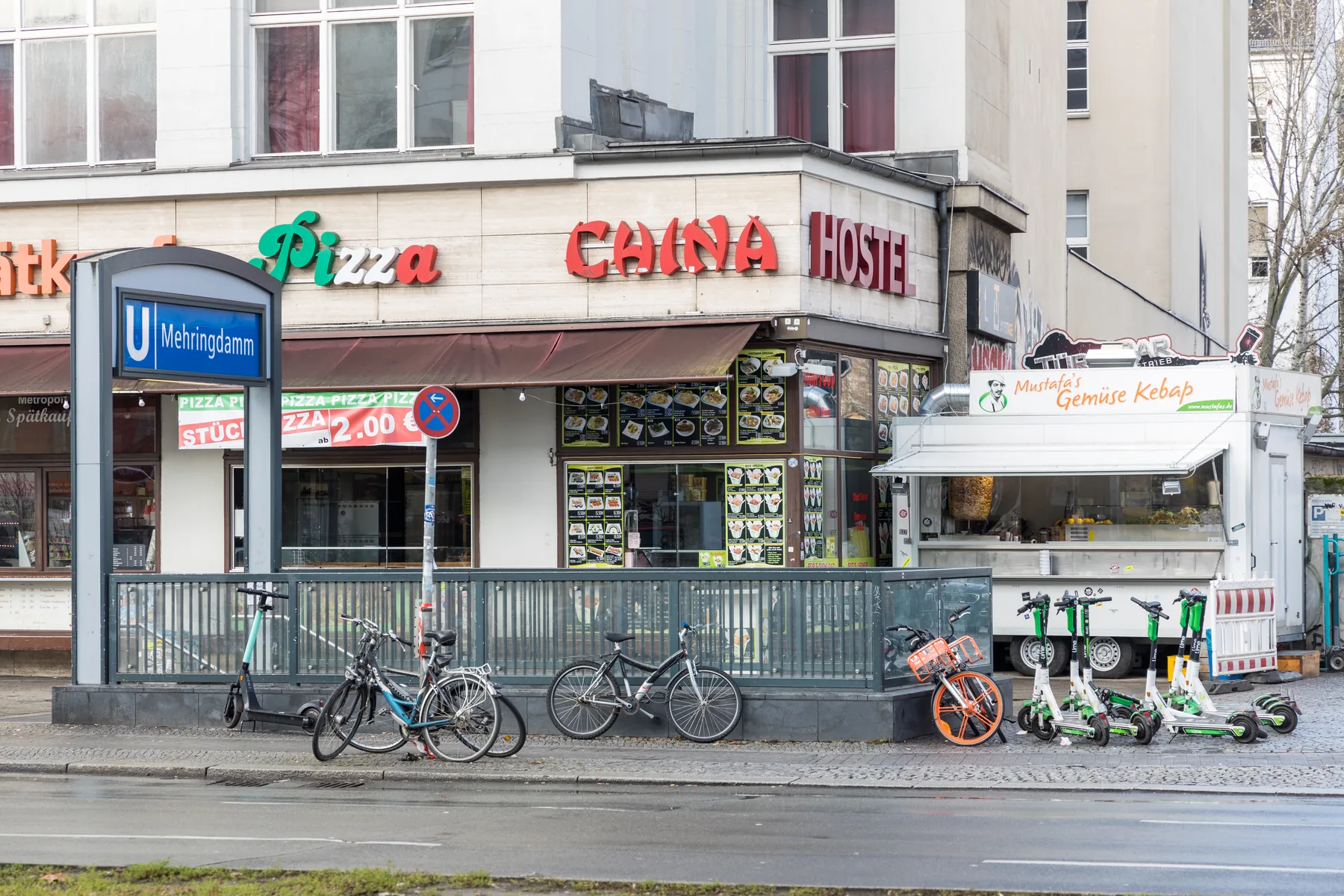
Current menus show the range. [GDK USA’s August 2026 menu](https://gdkusa.com/menu/) lists a Veggie Kebab with a jalapeño black-bean patty, salad, sauces, and toasted sesame bread. California operator [DonerG](https://donerg.com/) identifies falafel among its menu offerings. Berlin’s Mustafa’s Gemüse Kebap site confirms a [to-go vegetable-kebab stand](https://mustafas.de/), but it does not publish a full official ingredient list online; ask at the shop rather than treating “Gemüse” as proof that an order is meatless.
The same bread-and-salad architecture can hold meat or a vegetarian filling; the menu has to name which.
## Vegetarian and vegan are different checks
Yogurt and feta contain milk; mayonnaise-style garlic sauce can contain egg; bread commonly contains wheat and may carry sesame. A plant-based filling can share a grill, fryer, knife, or prep surface with meat. Whether that matters depends on dietary practice and allergy risk, but the menu label does not answer it.
| Filling | Vegetarian? | Vegan? | Extra check |
| --- | --- | --- | --- |
| Falafel | Usually | Often, if the mix and fryer allow | Shared oil with meat |
| Halloumi | Yes | No — it is cheese | Griddle contact with meat |
| Vegetable kebab | Only if no meat is added | Only if sauces and cheese are too | “Gemüse” can still mean chicken |
| Bean or plant patty | Usually | Depends on the binder and bun | Wheat, soy, egg |
See also [is there falafel döner](/is-there-falafel-doner/), [is there halloumi döner](/is-there-halloumi-doner/), and [is döner vegan](/is-doner-vegan/).
Seitan and other plant “döner” products appear in some German cities as a dedicated vegan line. They are still not the classic spit. US German-döner counters with a two-meat cone may have no vegetarian protein at all except salad. In that case a salad box without meat is a vegetable plate, not a substitute sandwich.
Ask for the named filling and a full ingredient check: Is “vegetable kebab” meatless? Is the sauce dairy- or egg-free? Is the bread vegan? Are fryer or grill surfaces shared? A vegetable-and-salad box without meat may be available even where no replacement protein exists, but it is nutritionally different from falafel or a bean patty.
If you eat fish or cheese but not meat, halloumi is the usual next ask; if you eat neither, falafel or a labeled vegan patty is the path. Extra salad in the bread is a vegetable sandwich unless that is actually what you want.
See [is döner healthy](/is-doner-healthy/), [what is a döner box](/what-is-a-doner-box/), and the [Döner Guide vegetarian chapter](https://donerguide.com/vegetarian/).
HTML: https://whatisdoner.com/is-there-a-vegetarian-doner/
## How many calories in a döner?
There is no single calorie number for “a döner.” A small chicken wrap and a large beef sandwich with two sauces, cheese, and fries are different meals even though both use meat from a vertical spit.
The largest variables are measurable:
- the weight and composition of the shaved meat;
- the size and recipe of the bread or wrap;
- the amount and oil, egg, or dairy content of the sauces;
- cheese and other add-ons;
- whether fries or rice are inside the item or form the base.
USDA’s [FoodData Central documentation](https://fdc.nal.usda.gov/about-us/) explains that its different datasets serve different purposes and that branded foods use label data. That is a reason to select the closest actual product, not to borrow one generic database entry for every shop.
## Why one shop’s numbers do not travel
Regional menus themselves differ. [GDK USA’s August 2026 menu](https://gdkusa.com/menu/) includes toasted sesame bread, a wholemeal multigrain option, wraps, boxes, rice, fries, and burgers. GDK’s Irish [allergen and nutrition page](https://germandonerkebab.com/ie/allergen-information) lists item-level nutrition for that market, but those values should not be assigned to a US recipe. Döner Haus’s public US menu describes its items but does not provide a complete nutrition table from which an item total can be stated.
A number from a blog post, a European chain PDF, or another city’s shop does not describe the US sandwich in your hand. “About 800 calories” is a guess.
| What you can do | What you cannot do |
| --- | --- |
| Use that operator’s current nutrition for that item | Quote a category-wide average |
| Compare two builds on the same menu | Transfer an Irish GDK figure to a US recipe |
| Ask for sauce on the side | Infer calories from the word “healthy” or “Kcal” |
## How to estimate a specific order
Use current nutrition published by the restaurant when it exists. Match the location, meat, bread, sauce, and add-ons. If no data exists, any estimate is an estimate: weigh or separately estimate the meat, bread, vegetables, and sauces using comparable database records. Sauce is hard to judge by sight, so a range beats a fake precise total.
A salad base usually removes bread; it does not prove that the meat and sauce portions stayed identical. A fries box may equal or exceed a sandwich depending on serving size. “Kcal” in an item name is a marketing label, not a nutrition panel.
Delivery photos are especially misleading. A tightly wrapped sandwich in a listing image may be a different size from the one in your bag, and the photo cannot show sauce weight. If you are logging food, log the operator, the item name, the meat, and the sauces — or skip the false precision.
Junior sizes, where they exist, are a real control. GDK’s Junior OG is a smaller sandwich on the same August 2026 menu, not a nutrition panel. Ordering sauce on the side is the other control you can actually use without a lab.
Compare options at the same shop rather than comparing unrelated shops. See [is döner healthy](/is-doner-healthy/), [what is a döner box](/what-is-a-doner-box/), and the deeper [Döner Guide calorie chapter](https://donerguide.com/calories/).
HTML: https://whatisdoner.com/how-many-calories-in-a-doner/
## Where can I get German döner in the US?
Look at the shop’s own location page, not a “coming soon” roundup. If you want the Berlin sandwich, start with Döner Haus:
- **Döner Haus** lists five New York City locations—Astoria, Bayside, East Village, Hell’s Kitchen, and Sunnyside—and Los Angeles on its [public location and menu page](https://doner.haus/). US franchise. Crispy Turkish pide, cabbage, garlic. Signed sites not yet open include West Palm Beach, two Long Island addresses, White Plains, and Oxford, Mississippi.
- **GDK USA** lists American Dream in East Rutherford, Astoria, Midtown Manhattan, Centereach, and Frisco on its [US site](https://gdkusa.com/). It sells US franchises. Toasted sesame waffle bread; the [UK allergen page](https://www.gdk.com/gb/allergen-information) states that beef doner contains poultry. Sugar Land, Bay Ridge, Westfield and Brighton Beach are marked permanently closed — more US closures than Kotti has restaurants.
- **DonerG** lists six California shops in Anaheim, Irvine, Santa Ana, Lake Forest, and Long Beach in its [official location directory](https://donerg.com/locations/). It identifies itself as Turkish and Mediterranean rather than specifically Berlin-style, which makes it a useful döner option without collapsing Turkish and German formats.
- **Kotti Berliner Döner Kebab** still lists six Manhattan and Brooklyn sites on its [location page](https://www.kottidoner.com/location), including food halls and a Dean Street storefront. Independent; it does not sell franchises. The Dean Street restaurant is marked permanently closed. The remaining sites are food halls. The menu sells beer and wine with the sandwich. As of the latest public owner reply, the chicken is not certified halal.
- **Doner Shack** has no open US restaurant. It issued a US FDD and, as of 2026, is not selling US franchises. The [franchise site](https://donershackfranchise.com/) says US enquiries are on hold, while listing 150 India master-franchise deals as signed. A signed unit in Prosper, Texas, is still “coming soonish.” You cannot eat there.
Those lists were checked in August 2026. Shops open and close, and plenty of places serve döner without putting “German” on the sign.
Doner Shack’s advertised first US unit in Prosper, Texas. The sign is up. The interior is dark. US franchise enquiries are on hold.A street-facing counter is one US format; malls, food halls, and fast-casual rooms appear too.
## How to tell you found the right food
Read the operator’s own menu. Look for meat shaved from a vertical spit, then note the bread, vegetables, and sauces. A German-style sandwich often uses cut or toasted flatbread and cabbage or mixed salad. Turkish döner may appear as a plate, wrap, or sandwich. Greek gyro and Levantine shawarma share the machine but are different menu traditions.
Halal chicken-and-rice can be excellent without being döner. A waffle loaf does not make a UK chain the Berlin sandwich.
| If you are in… | Start with | Then confirm |
| --- | --- | --- |
| New York City | Döner Haus locator | That day’s hours and menu |
| Los Angeles | Döner Haus locator | The live LA address on [doner.haus](https://doner.haus/) |
| New Jersey / Long Island / Dallas–Frisco | GDK USA | The specific mall or street address — and whether that unit is still open |
| Orange County / Long Beach | DonerG | Whether you want Turkish plates or a Berlin sandwich |
| Prosper, Texas | Doner Shack’s own location page | It is signed. It is not published as open. |
| Anywhere else | Local search plus the operator’s own site | Spit, bread, and sauce — not just the word kebab |
City pages: [where in NYC](/where-in-nyc/), [where in Los Angeles](/where-in-los-angeles/). There is still [no complete US shop count](/how-many-us-doner-shops/).
Confirm the address on the official location page on the day you go, then open that location’s current menu. If you care about the format, ask which meat is on the spit, whether it is sliced to order, and what bread and sauce come by default. If halal or allergens matter, ask those as separate questions.
See [what is a German döner](/what-is-a-german-doner/), [döner vs gyro](/doner-vs-gyro/), and the broader [Döner Guide US chapter](https://donerguide.com/german-doner-in-the-us/).
HTML: https://whatisdoner.com/where-can-i-get-german-doner/
## Is döner spicy?
Usually not by default, but it depends on the shop and sauce choice. “Spiced” and “spicy-hot” are different: döner meat can contain aromatic seasoning without producing chile heat.
At many German shops, a customer chooses among garlic, herb, and hot sauces or is asked whether the order should be *scharf* (hot). Dried chile flakes may be added separately. Other operators build a fixed set of sauces into the item, so the hot component must be removed when ordering.
Current US menus illustrate the variation. [GDK USA’s August 2026 menu](https://gdkusa.com/menu/) identifies a spicy signature sauce on its Kcal Kebab and lists jalapeños among add-ons, while its original uses three signature sauces. [Döner Haus’s East Village menu](https://doner.haus/menu/doner-haus-east-village) describes creamy garlic sauce on the standard sandwich. Those are two shops’ defaults, not a heat scale for the whole food.
A creamy zigzag does not show heat; chili may be a separate sauce or a sprinkle of flakes.
## What can make it hot?
Heat may come from a red chile sauce, pul biber or other dried pepper, fresh jalapeño, or a branded hot sauce. Garlic itself is pungent but not chile-hot. Tahini is sesame-based and not inherently hot; toum is garlic-based and not inherently hot; a white sauce can be mild even when the meat is strongly seasoned.
Cross-cultural menu borrowing makes simplistic rules unreliable. Shawarma is often described as more aromatic, but it may be served without hot sauce. Gyro can receive hot sauce even though tzatziki is cooling. The item description and sauce bottle matter more than the cuisine label.
| German counter phrase | What you are asking |
| --- | --- |
| *Scharf?* | Chile heat, yes or no |
| *Ein bisschen scharf* | A little heat |
| *Nicht scharf* | No chile finish |
| *Welche Soße?* | Which sauce, which may or may not be hot |
See [what scharf means](/what-is-scharf/) for the word itself.
If you avoid heat, ask which sauce is spicy and whether it is normally included; request it omitted or served separately. If you want heat, ask for the shop’s chile option by name and start with a small amount. If an allergy is involved, “not spicy” says nothing about milk, egg, sesame, or garlic.
Pul biber (Aleppo-style flakes) is a common German-Turkish shaker: fruity heat rather than a vinegar hot sauce. Jalapeños on a US menu are a different heat and a different texture. “Flaming” seasoning on fries, as on GDK’s August 2026 sides list, can make a mild sandwich feel hot because of the side, not the döner.
If you are splitting an order, put chili on the side so one person is not stuck with a fully scharf sandwich. Children and first-timers should answer no first; you can always add flakes. See [is döner good for kids](/is-doner-good-for-kids/).
Meat that tastes “spicy” without chile is usually salt, pepper, paprika, or garlic. That is seasoning. Scharf is the extra heat you can refuse.
See [what sauces go on döner](/what-sauces-go-on-doner/) and the deeper [Döner Guide sauce chapter](https://donerguide.com/sauces/).
HTML: https://whatisdoner.com/is-doner-spicy/
## What is an imbiss?
An *Imbiss* is a small meal and, by extension, a place selling quick food. In everyday English, “snack bar,” “snack stand,” or “takeaway counter” is usually closer than “restaurant.” Duden defines [*Imbiss*](https://www.duden.de/rechtschreibung/Imbiss) as a small meal and [*Schnellimbiss*](https://www.duden.de/rechtschreibung/Schnellimbiss) as a quick-service establishment offering one.
The word covers more than döner: currywurst stands, sausage counters, fried-food shops, kiosks, and small takeaways can all be Imbisse. Some have only a service window; others have stools, high tables, or a modest dining area. “No seats” is common, not a definition.
Mustafa’s Gemüse Kebap operates here from a compact trailer with a pavement queue: a clear imbiss service pattern, though not the only one. Photograph by JoachimKohler-HB, CC BY-SA 4.0.
## Why the format suits döner
A vertical spit, cutting station, bread, salad, and sauces can support food assembled to order at a counter. Takeaway reduces the space and service required for a dining room. Berlin’s official visitor guide includes early snack counters such as [Lale Imbiss](https://www.visitberlin.de/de/lale-imbiss), while Mustafa’s official site describes its Mehringdamm location as [to-go with a frequent queue](https://mustafas.de/).
Seated döner shops are still döner shops. Turkish restaurants may serve döner on plates; US operators may use malls, food halls, or fast-casual dining rooms. *Imbiss* describes a service format.
| What you may see | What it usually means |
| --- | --- |
| Service window, pavement queue | Classic imbiss pattern |
| Stools or standing tables | Eat here without a dining room |
| Food-hall stall | Shared seating, still counter service |
| Full Turkish restaurant | Plates and tables; still can serve döner |
US “fast casual” overlaps in speed but is an industry box, not a translation. A compact New York counter can feel like an imbiss without using the German word. A mall food court can serve excellent spit meat without resembling a Berlin kiosk.
Expect to order and pay at a counter unless signs say otherwise. Check whether seating belongs to the shop or a shared food hall. If the menu says *Teller*, expect a plate; *Dürüm* means a wrap; a standard döner may arrive in bread and paper.
Cash-only windows still exist in Germany; cards are common too. A queue is part of the format. If you need a table, look for *Restaurant* or visible seats rather than assuming every döner is an imbiss. US compact counters can feel identical without using the German word — Döner Haus’s public New York shops are takeaway-led; GDK’s mall units are still counter service inside a larger building.
See [how to eat a German döner](/how-do-you-eat-a-doner/) and the [Döner Guide ordering chapter](https://donerguide.com/how-to-order/). For late hours, see [is döner late-night food](/is-doner-late-night-food/).
An imbiss is a service pattern. Judge the spit and the salad, then decide whether you wanted to stand or sit.
HTML: https://whatisdoner.com/what-is-an-imbiss/
## What is a kebab shop?
“Kebab shop” is the everyday English term for a small takeaway whose central piece of equipment is a vertical spit. It is a British, Irish, Australian and New Zealand phrase more than an American one, and it describes a business model rather than a cuisine: counter service, a short assembled menu, long evening hours, usually independently owned.
The menu almost always runs wider than döner. [King Kebab House](https://www.kingkebabhouse.com.au/) in Campbelltown, New South Wales, reviewed in August 2026, fronts its site with kebabs, halal snack packs and pizzas together — a combination that would look strange in a Berlin *Imbiss* and is completely ordinary in Australia. *Gourmet Traveller’s* [explainer on the halal snack pack](https://www.gourmettraveller.com.au/explainers/halal-snack-pack-explainer-2303/) describes that dish as available from most kebab stores, which is a useful indication of how standard the format is across the country. Those describe one shop and one national pattern, not a definition every kebab shop must meet.
The German version of the same business: a compact counter, a pavement queue, no dining room. Photograph by JoachimKohler-HB, CC BY-SA 4.0.
## The same shop under different names
| Country | Usual word | What tends to come with it |
| --- | --- | --- |
| UK and Ireland | Kebab shop | Chips, burgers, sometimes pizza; late hours |
| Germany | Imbiss | Döner, currywurst, chips; see [what is an imbiss](/what-is-an-imbiss/) |
| Netherlands | Shoarmazaak or snackbar | Kapsalon, schotels, fried snacks |
| Australia | Kebab shop | Snack packs, pizza, chicken salt |
| United States | Usually just the operator’s name | Fast-casual or food-hall counter |
The American gap in that table matters. The US has plenty of shops doing this work, but no settled everyday word for them, which is part of why döner arrives in the country as a series of brands rather than as a familiar type of shop. Some are compact takeaway counters; [Kotti Berliner Döner Kebab](https://www.kottidoner.com/menu) runs food-hall stalls; others are full fast-casual dining rooms.
The phrase does not grade the food, and it does not guarantee a döner cone. A grill house that skewers and chars meat to order is a *shish* operation, using the same word for a different cooking method. If you want spit meat, the evidence is the spit, turning, with a browned outer layer being shaved. See [is döner the same as kebab](/is-doner-the-same-as-kebab/).
Expect to order at a counter, expect chips to be on the menu, and expect the hours to follow the neighbourhood rather than the cuisine — see [is döner late-night food](/is-doner-late-night-food/).
If you want the Berlin sandwich specifically, a kebab shop is a promising place to find spit meat and an unreliable place to find toasted quartered pide with a heavy raw-cabbage load. Look at the bread and the salad before you assume. [Where can I get German döner in the UK](/where-in-the-uk/) works through that distinction.
HTML: https://whatisdoner.com/what-is-a-kebab-shop/
## Is döner street food?
Yes as a description of what the food is for, and only partly as a description of where you will buy it. The Berlin sandwich was designed to be handed over a counter and eaten on the move: bread that closes around the filling, paper that acts as a handle, nothing that needs cutting. Berlin’s official visitor site describes the city’s [döner as a flatbread pocket of meat, salad and sauce](https://www.visitberlin.de/en/doner-kebab), presents the city as Germany’s home of street food, and lists the snack stands and kebab houses that sell it.
What has changed is the retail. In August 2026, [DonerG](https://donerg.com/) described itself as serving Turkish street food while operating six California restaurants in a fast-casual format. German Doner Kebab’s own site markets the opposite of a pavement queue — “nothing beats a dine-in doner,” with a stool, booth or table, on its [allergen and country page](https://germandonerkebab.com/ie/allergen-information). [Kotti Berliner Döner Kebab](https://www.kottidoner.com/menu) sells the same fillings across sandwiches, wraps and bowls, including from food-hall stalls. Three operators, three answers, none of which redefines the dish.
The build assumes this: one meal, two hands, no table. Plenty of shops still expect you to sit.
## Two different claims people are making
| The claim | Is it true? |
| --- | --- |
| “It was designed as portable food” | Yes — the bread and wrapper exist for that |
| “Real döner is only sold from kiosks” | No — plated döner is long-established in Turkey |
| “Street food means cheap” | No; price follows the city and the shop |
| “Street food means late” | No; hours follow the neighbourhood |
| “A dining room makes it inauthentic” | No; it makes it a different service model |
“Street food” also shows up as marketing. Operators in air-conditioned rooms with seating and table numbers still use it to point at the dish’s heritage — lineage, not a description of the room.
There is a practical corner where the answer genuinely matters. A vertical spit needs a fixed power supply, a hood and space to work beside, which is why döner is far more common from a permanent counter than from a truck or a market stall. Where you do find it at a stall, the meat has often been cooked and shaved elsewhere. That is a real difference from meat shaved to order in front of you.
“Street food” describes how the sandwich is built. Standing or sitting is a separate choice.
For the shop formats themselves, see [what is an imbiss](/what-is-an-imbiss/) and [what is a kebab shop](/what-is-a-kebab-shop/). For eating it upright without wearing it, see [how do you eat a döner](/how-do-you-eat-a-doner/).
HTML: https://whatisdoner.com/is-doner-street-food/
## FAQ
**What is it?** A German döner is the Berlin-style version of the Turkish döner kebab: seasoned meat stacked on a vertical rotisserie, shaved thin, and served in toasted flatbread with crisp vegetables and sauces. [Full answer](/what-is-a-german-doner/).
**What should I order first?** The shop’s standard sandwich, everything on it, one creamy sauce, chili on the side. [Full answer](/what-should-i-order-first-time/)
**What does döner mean?** To turn. The meat rotates on a vertical spit. Döner kebab means rotating roasted meat.
**Where did it come from?** The Berlin format developed among Turkish immigrant entrepreneurs around the early 1970s. The turning-spit method existed earlier in Turkey, and the identity of a single inventor is disputed. [Is it Turkish?](/is-german-doner-turkish/)
**Gyro?** No. Greek gyro commonly uses soft pita and tzatziki. [Döner vs gyro](/doner-vs-gyro/) and [is it the same as a gyro?](/is-doner-the-same-as-a-gyro/)
**Shawarma?** No. Levantine shawarma commonly uses aromatic spices, pickles, tahini, or toum. [Döner vs shawarma](/doner-vs-shawarma/)
**Kebab?** Döner is the turning-spit kind of kebab; shish and Adana are others. [Full answer](/is-doner-the-same-as-kebab/)
**Meat?** Beef, veal, lamb, chicken, turkey, and mixtures all appear. [What meat](/what-meat-is-in-doner/) · [Chicken or beef](/chicken-or-beef/) · [Mixed döner](/what-is-mixed-doner/)
**Pork?** Not normally, and German naming practice does not allow the name on a pork product at all. [Full answer](/is-there-pork-in-doner/)
**Halal?** It can be. Ask what a current certificate covers. [Is döner halal?](/is-doner-halal/)
**Gluten-free meat?** Only when ingredients and handling support that claim. Conventional bread contains wheat. [Full answer](/is-the-meat-gluten-free/)
**Bread?** Often cut pide or fladenbrot; dürüm wraps are common too. [What bread](/what-bread-is-doner-served-on/) · [Dürüm vs pide](/durum-vs-pide/) · [What is pide?](/what-is-pide/)
**Sauces?** Garlic, yogurt, herb, and chili are common. [What sauces](/what-sauces-go-on-doner/) · [What is white sauce?](/what-is-white-sauce/) · [Which sauce](/which-sauce-should-i-get/) · [Does it have garlic?](/does-doner-have-garlic/) · [What is scharf?](/what-is-scharf/)
**What comes on it, and how big is it?** Meat, bread, raw salad, sauce; the portion is the operator’s decision. [What comes on it](/what-comes-on-a-doner/) · [How big is it](/how-big-is-a-doner/)
**Box or plate?** Same fillings on fries, salad, or rice, in a container or on a plate. [What is a box](/what-is-a-doner-box/) · [What is a plate](/what-is-a-doner-plate/) · [Box vs sandwich](/box-vs-sandwich/)
**Healthy / calories?** It can combine protein, vegetables, and grain. There is no category-wide calorie count. [Healthy?](/is-doner-healthy/) · [Calories](/how-many-calories-in-a-doner/)
**How do you eat it?** Keep the sandwich partly wrapped and use both hands; the box, bowl and plate are fork food. [Full answer](/how-do-you-eat-a-doner/) · [Fork or hands](/is-doner-eaten-with-a-fork/)
**Keeping it?** Chill it fast, reheat the meat hot, and expect the salad and bread to suffer. [Leftovers](/leftovers/) · [Reheating](/can-you-reheat-doner/) · [Freezing](/can-you-freeze-doner/) · [Eating it cold](/is-doner-good-cold/)
**Vegetarian / vegan / falafel / halloumi?** Some shops offer falafel, halloumi, vegetables, or plant-based patties. Classic döner is meat. [Vegetarian](/is-there-a-vegetarian-doner/) · [Vegan](/is-doner-vegan/) · [Falafel](/is-there-falafel-doner/) · [Halloumi](/is-there-halloumi-doner/)
**Dairy / sesame / nuts?** Yogurt sauce and cheese are common dairy sources; sesame is common on the bread; nuts are not a standard ingredient. Ask the shop either way. [Dairy](/does-doner-contain-dairy/) · [Sesame](/does-doner-contain-sesame/) · [Nuts](/does-doner-contain-nuts/)
**Spicy?** Not by default. Chili is usually on request. [Is it spicy?](/is-doner-spicy/)
**Kids?** Heat, portion size, and allergens are the usual limits. [Good for kids?](/is-doner-good-for-kids/)
**Ayran?** A salted yogurt drink, not a default US side. [What is ayran?](/what-is-ayran/)
**Cost?** Varies by city and shop; check the posted menu. German street prices are not US prices. [How much](/how-much-does-a-doner-cost/)
**Late night?** Often in German nightlife districts; US hours are local. [Late-night food?](/is-doner-late-night-food/)
**Where?** Look at the shop’s own location page. [US](/where-can-i-get-german-doner/) · [NYC](/where-in-nyc/) · [Los Angeles](/where-in-los-angeles/) · [UK](/where-in-the-uk/) · [Germany](/where-in-germany/) · [How many US shops?](/how-many-us-doner-shops/)
**Imbiss? Kebab shop?** Both names for a small counter built around a spit — German and everyday English. [What is an imbiss](/what-is-an-imbiss/) · [What is a kebab shop](/what-is-a-kebab-shop/) · [Is it street food?](/is-doner-street-food/)
**Lahmacun, kapsalon, snack pack?** Related items that appear on the same menus. [Lahmacun](/what-is-lahmacun/) · [Kapsalon](/what-is-a-kapsalon/) · [Halal snack pack](/what-is-a-halal-snack-pack/)
**US franchises?** More than one company has filed. [Franchise category](/is-german-doner-a-us-franchise-category/)
What the shop looks like
### Counter service and takeaway. A queue on the pavement. {: .display }
Counter service and takeaway can support a compact room, but shop size, equipment, staffing, hours, and seating vary by operator and location.
A street-facing storefront can combine a compact counter with direct takeaway access.Customers wait on the pavement and eat as they walk.
For long-form chapters, use [Döner Guide](https://donerguide.com/).
HTML: https://whatisdoner.com/faq/
## How much does a döner cost?
It depends on the city, the shop, the size, and the meat. A Berlin imbiss, a London takeaway, a Manhattan counter, and a Texas mall kiosk are different businesses. There is no usable US average to quote.
Germany’s statistical office tracks food and restaurant prices, not a dedicated döner series. In 2024, restaurant and accommodation prices rose faster than the overall German consumer-price index; the [official November 2024 release](https://www.destatis.de/EN/Press/2024/12/PE24_463_611.html) reported a 5.9 percent year-over-year increase for that broad category. That still does not reveal the price of a sandwich in Berlin or Munich, and it says nothing about New York.
Informal “döner indexes” compiled from reviews or small menu samples are not government statistics. German street prices are not US prices.
The board in front of you is the price list that matters; a photo from another city is not.
## How to check the number that applies to you
1. Open the shop’s current menu — in the window, on the operator’s site, or on the kiosk — on the day you order.
2. Match the exact item: sandwich, wrap, box, meat, size, and included sauce.
3. Note extras: cheese, extra meat, fries, a drink.
4. If you are comparing delivery, remember that app prices and fees are not the counter price.
[GDK USA’s August 2026 menu](https://gdkusa.com/menu/) shows why a single number fails even inside one brand: it sells a full Original, a Junior OG, wraps, boxes, burgers, and add-ons. Those are different products. Prices live on that board, not in an article that would go stale overnight.
| What changes the bill | Example |
| --- | --- |
| City and rent | A Manhattan counter versus a suburban mall |
| Format | Sandwich, dürüm, fries box, rice bowl |
| Size | Junior or regular, where offered |
| Meat | Chicken, beef, mix, or a vegetarian filling |
| Channel | Counter, delivery app, or airport/mall markup |
Treat price as you treat hours: check it that day. If you are traveling, do not budget from a German blog or from a US article that quotes one shop. For what you get at each price point, compare [box vs sandwich](/box-vs-sandwich/) and [dürüm vs pide](/durum-vs-pide/) on the same menu rather than across countries.
Tourist-facing Berlin shops near stations can charge more than a neighborhood imbiss a few stops away. US food halls add rent to the same sandwich idea. Delivery apps add fees on top of the counter board. None of those markups is a “döner inflation index.”
If you are comparing two US operators, compare the same format: a regular chicken sandwich to a regular chicken sandwich, not a loaded fries box to a junior wrap. Size names are marketing. The scale at the counter is not published. Read the posted menu.
The [Döner Guide chapter on how Germans eat döner](https://donerguide.com/how-germans-eat-doner/) is the longer look at everyday value.
HTML: https://whatisdoner.com/how-much-does-a-doner-cost/
## Chicken or beef döner?
Chicken and beef are the two döner meats most US customers are asked to choose between. Döner names the turning spit; the shop names the animal.
[Döner Haus’s East Village menu](https://doner.haus/menu/doner-haus-east-village) offers chicken or beef and says the meat has no fillers. [GDK USA’s August 2026 menu](https://gdkusa.com/menu/) offers beef, chicken, or mixed; its [UK allergen page](https://www.gdk.com/gb/allergen-information) states that beef doner contains poultry for added juiciness. If you ordered beef and do not eat chicken, that page is the one that matters. Lamb and veal remain common in Germany and in some Turkish restaurants; they are simply less often the default pair on US German-döner boards.
The browned outer layer is what you eat; the species is written on the menu, not on the machine.
## How they tend to differ
Typical differences, which still vary by shop:
| | Chicken | Beef |
| --- | --- | --- |
| Texture | Often finer slices, can read as lighter | Often richer, sometimes coarser |
| Seasoning | Can take a more aromatic marinade | Often milder or more savory |
| Who often picks it | Customers avoiding red meat | Customers expecting a “classic” kebab |
| What you still must ask | Binders, halal scope, gluten | The same questions |
A chicken sandwich in toasted pide with cabbage is still German-style döner. A beef wrap is still döner. Mixed can be the practical answer if you want both textures in one order — once you know whether “mixed” means two shaved meats or one formulated cone.
Halal status, gluten, and fillers do not follow automatically from the species. See [what meat is in döner](/what-meat-is-in-doner/) and [is döner halal](/is-doner-halal/).
## How to order it clearly
- Name the meat first, then the bread or box.
- If you want mix, ask whether that is half-and-half off two spits.
- If you care about fat or seasoning, ask which cone is on today rather than arguing from a memory of another shop.
- If you do not eat one species, say so before the cook starts assembling.
Pick the meat you want to eat, then judge the shop by the spit, bread, salad, and sauce. For the wider species list, including veal, lamb, and turkey, read the [Döner Guide meat chapter](https://donerguide.com/meat-and-halal/).
If you are trying döner for the first time, chicken is often the milder introduction at US counters, because some beef cones are more heavily seasoned or minced. If you already like gyro beef-and-lamb, you may prefer beef döner — and you should still notice the bread and sauce are different. See [döner vs gyro](/doner-vs-gyro/).
Allergies do not care which animal you picked. A chicken cone can contain wheat; a beef cone can contain milk. Ask the ingredient question after you pick a species, not instead of picking one.
“Mix” is a third button on many US boards. If you cannot choose, it is a fair first order — once you know it is two meats and not a mystery loaf. If you do not eat one of the animals, do not press mix.
HTML: https://whatisdoner.com/chicken-or-beef/
## Dürüm vs pide
*Pide* (in döner shops, often a quarter of round Turkish-style flatbread) and *dürüm* (a thin rolled wrap) are two carriers for the same spit meat, salad, and sauce. They change how the sandwich holds, leaks, and travels.
Berlin döner is famous as a stuffed, often toasted pocket. A dürüm — also called yufka in some shops — rolls the fillings into a cylinder. English menus may say wrap, dürüm, durum, or yufka. [Döner Haus’s August 2026 East Village menu](https://doner.haus/menu/doner-haus-east-village) describes crispy Turkish pide for the sandwich and a grilled tortilla for the wrap — the Berlin pocket first. [GDK USA](https://gdkusa.com/menu/) sells toasted sesame waffle bread and a separate flatbread wrap. Waffle bread is not pide.
Cut pide makes a deep pocket; a dürüm would roll the same pile into a cylinder.
## Side by side
| | Pide sandwich | Dürüm wrap |
| --- | --- | --- |
| Bread | Thicker flatbread, often sesame-topped | Thin sheet, sometimes yufka, sometimes a tortilla |
| Shape | Pocket or triangular wedge | Cylinder |
| Eating | Two hands, keep the paper on | Peel the paper down as you go |
| Salad load | Easy to pile high | Can squeeze out the ends if overfilled |
| Travel | Sturdy if toasted | Neat until steam softens it |
Neither format is a gluten-free workaround. Both are usually wheat. Sesame is more often on the pide. See [what bread is döner served on](/what-bread-is-doner-served-on/) and [what pide is](/what-is-pide/).
Operators sometimes add a third carrier rather than choosing between these two. [Kotti Berliner Döner Kebab’s August 2026 menu](https://www.kottidoner.com/menu) sells its signature döner in toasty Turkish pide, a wrap in a tortilla, and a taco-shaped version of the same wrap filling for eating on the move. That is one shop’s answer to the same problem the pide-or-dürüm choice is about — how much bread, how much structure, how easily carried — and it is a reminder that the two traditional names do not exhaust the options on a modern menu.
## How to choose
Choose pide if you want the Berlin postcard sandwich and a toasted crust. Choose dürüm if you want something you can eat one-handed on a train or if the shop’s wrap is what they do well. If the wrap is a flour tortilla, you are still ordering döner fillings in that shop’s bread — not a Mexican burrito, and not Turkish yufka by default.
Ask *im Brot* for bread and *als Dürüm* in Germany if you want to be precise. In the US, “sandwich” and “wrap” are usually enough if you then confirm the bread.
The [Döner Guide bread chapter](https://donerguide.com/bread/) goes deeper on fladenbrot, pide, and wraps.
A dürüm is often the better one-handed walk. A pide sandwich is the better sit-down (or stand-still) pile. If you want leftovers, neither wrap nor pide stores well once sauced; a box still wins for the fridge. If you want maximum salad, the pocket usually holds more without squeezing out the ends.
Some shops grill the dürüm after filling, which toasts the outside. The meat is unchanged. If the wrap is huge, it is still one order; portion is a shop habit.
If sesame on pide is the problem, dürüm is often the easier bread. Confirm the wrap. If gluten is the problem, neither format is a workaround; see [is the meat gluten-free](/is-the-meat-gluten-free/).
HTML: https://whatisdoner.com/durum-vs-pide/
## Döner box vs sandwich
The sandwich is the Berlin street form: toasted or cut flatbread packed with shaved meat, vegetables, and sauce. The box is the fork form: the same shop’s meat and toppings in a container.
[GDK USA’s August 2026 menu](https://gdkusa.com/menu/) lists the Original sandwich, a wrap, a fries box, a fries-and-salad box, a salad-focused gym box, and a rice bowl. [Döner Haus](https://doner.haus/menu/doner-haus-east-village) lists sandwich, wrap, and box side by side. That reuse of one spit across formats is the point.
Sandwich, wrap, and box are three builds from one filling station.
## What actually changes
| | Sandwich | Box |
| --- | --- | --- |
| Hands | Two hands, paper on | Fork |
| Bread | Usually wheat pide or similar | Optional; sometimes on the side |
| Base | The bread | Fries, salad, rice, or a mix |
| Travel | Messy if unwrapped | Steam softens fries under a lid |
| Gluten | Bread is the obvious wheat | Meat, sauce, and fryer still count |
A box is related to a German *Dönerteller* (plate) but is usually smaller and more portable. A “bowl” on a US menu is often the same idea with a wider dish. See [what is a döner box](/what-is-a-doner-box/).
## When to pick which
The sandwich if you want the Berlin eating experience and a toasted crust. A salad box if you want to skip bread — then still ask about sauce and meat portion. A fries box if you want a hot, saucy fork meal; it will not be a lighter sandwich. Rice if the shop’s rice bowl is what they actually cook well.
Calories do not follow the heading. There is no category-wide count; see [how many calories](/how-many-calories-in-a-doner/). For gluten, see [is the meat gluten-free](/is-the-meat-gluten-free/).
The [Döner Guide box chapter](https://donerguide.com/the-doner-box/) covers box, bowl, and plate variations.
The sandwich keeps the toasted crust; a box is easier at a desk with a fork. If you will refrigerate part of it, the box also lets you keep sauce off the meat; see [leftovers](/leftovers/).
Loaded fries sit next to this choice rather than inside it. GDK’s August 2026 menu lists doner fries with cheese as a separate item — a side or a meal of its own.
An undecided order can be the sandwich and a small fries rather than a fries box: toasted bread plus potatoes, and the spit meat in its classic form.
HTML: https://whatisdoner.com/box-vs-sandwich/
## Is döner good for kids?
Döner can be a practical family meal: protein, vegetables, and bread in one order. Size, heat, mess, and allergens still have to be controlled. The same sandwich that works as late-night street food can be too hot, too large, or too messy for a small eater.
Heat is the first control. German counters often treat chile as optional; see [is döner spicy](/is-doner-spicy/) and [what scharf means](/what-is-scharf/). Garlic sauce can still be strong. If a child avoids onion or cabbage, say so — “with everything” is local shorthand, and shops rarely keep a separate children’s menu.
Fries are a familiar side; a fries box is a different, heavier meal than a small sandwich.
## A practical checklist
- **Heat:** no chili, no jalapeños, sauce on the side.
- **Size:** ask for a junior item if it exists, or plan to split an adult sandwich.
- **Format:** a box with a fork is easier at a table than a standing pide.
- **Allergens:** wheat in bread, sesame on the loaf, milk or egg in sauce, possible nuts only if the shop uses them — ask, do not assume.
- **Halal:** if that matters to your household, ask about the certificate, not the cuisine name.
- **Seating:** a food hall or shop with tables beats a pavement queue with a dripping sandwich.
[GDK USA’s August 2026 menu](https://gdkusa.com/menu/) lists a Junior OG — the Original flavors in a smaller toasted waffle bread — which is an operator example of a reduced size, not a category standard. Döner Haus’s public sandwich, wrap and box menu is the board; ask at the counter for a smaller build.
| Situation | Often easier | Often harder |
| --- | --- | --- |
| First try | Chicken, no chili, extra napkins | Mixed sauces, jalapeños |
| Toddler | Box or plate, seated | Walking with a stuffed pide |
| Allergy | Written ingredients, sauce separate | Assuming “kids’ food” is simple |
| Late night | Earlier seating, smaller order | A crowded standing queue |
This is not medical advice. For allergies, speak to the restaurant and, if needed, a clinician. There is no child-specific calorie figure that would hold across shops; see [how many calories](/how-many-calories-in-a-doner/).
Sharing an adult sandwich is often cleaner than ordering a second full one “for the kid” who will eat four bites. Keep napkins in reach; cabbage and sauce escape. If the child will only eat meat and bread, you can ask for less salad rather than inventing a children’s menu the shop does not have.
Onion, raw cabbage, and strong garlic are the usual flavor objections, not the spit itself. A mild chicken dürüm at a table solves more first visits than a standing beef sandwich with mixed sauces. If the outing is a late-night stop, earlier is easier; see [is döner late-night food](/is-doner-late-night-food/).
A mild order, sauce on the side, and a format the child can actually eat. If the shop has a junior sandwich, that is the cleanest size control. If not, split an adult order and skip the fries box unless you want that meal.
See [how to eat a döner](/how-do-you-eat-a-doner/) and the [Döner Guide on how Germans eat](https://donerguide.com/how-germans-eat-doner/).
HTML: https://whatisdoner.com/is-doner-good-for-kids/
## Can you reheat döner?
The spit meat reheats. Toasted pide dries or toughens; raw cabbage and tomato collapse; creamy sauce separates. The stuffed sandwich will not return to the moment it left the counter.
The US Department of Agriculture’s [leftovers and food-safety page](https://www.fsis.usda.gov/food-safety/safe-food-handling-and-preparation/food-safety-basics/leftovers-and-food-safety) is the rule set to follow, not a döner-specific myth. Refrigerate within two hours of cooking or serving (one hour if the surrounding temperature is above 90°F). Reheat leftovers to 165°F (74°C). Eat refrigerated leftovers within three to four days, or freeze them.
Meat reheats; the salad that sat on it overnight does not come back to life.
## What to separate
If you know you will have leftovers, ask for sauce on the side and keep salad off the meat. A [box](/what-is-a-doner-box/) with fries will never re-crisp like a fresh fryer basket; a salad box is mostly a next-day meat-and-greens problem.
| Component | Reheat? | Better move |
| --- | --- | --- |
| Shaved meat | Yes, until steaming | Covered skillet or microwave with a splash of water |
| Pide or wrap | Optional, briefly | Toast separately; do not soak it in sauce first |
| Raw salad | No | Eat fresh or discard |
| Creamy sauce | Poorly | Keep cold and add after, if it still smells and looks sound |
| Fries | Poorly | Oven or skillet; expect softness |
A whole wrapped sandwich in the microwave is the worst common method: the bread steams, the outside stays cold in spots, and the lettuce turns to slime. Pull it apart.
If the meat sat out on a desk through a long afternoon, throw it away rather than reheating it. For storage details, see [leftovers](/leftovers/).
Reheat the meat hot, refresh the bread if you still want it, and replace the salad. For how the fresh version is meant to be eaten, see [how to eat a döner](/how-do-you-eat-a-doner/).
A covered skillet with a spoon of water is more even than a blast of dry microwave heat. Stir once so the thin slices do not fry into shards on one side and stay cold on the other. If you use an oven, spread the meat; a foil-wrapped stuffed sandwich will steam the bread into leather.
Do not reheat in a slow cooker “until whenever.” The USDA leftover page is about getting food through the temperature danger zone, not about holding it warm all afternoon. If you packed a box for a later train, keep it cold, then reheat, or eat it cold only if it was refrigerated on time and still smells right.
Sauce that was left on meat overnight will taste louder and look broken. That is quality, not automatically safety, but it is a reason to keep sauce separate when you know you will have leftovers. A fresh lemon wedge, if the shop has one, helps a reheated plate more than another ladle of yesterday’s garlic.
HTML: https://whatisdoner.com/can-you-reheat-doner/
## Can you freeze döner?
The shaved meat freezes well. The assembled sandwich does not: salad, creamy sauce, and toasted bread lose their texture. That distinction is the whole page.
The USDA’s [freezing and food safety guidance](https://www.fsis.usda.gov/food-safety/safe-food-handling-and-preparation/food-safety-basics/freezing-and-food-safety) is unusually direct about this. Food held constantly at 0°F is safe indefinitely, and freezing does not destroy nutrients — but the same page names mayonnaise, cream sauce and lettuce as examples of foods that simply do not freeze well. A German döner is meat wrapped around exactly those two problems. The guidance also gives a quality window rather than a safety one for cooked meat: two to three months at 0°F, after which it is still safe and progressively less good.
A box freezes no better than a sandwich. Fries and salad are the parts that will not come back.
## What to do with each part
| Component | Freeze? | Why |
| --- | --- | --- |
| Shaved meat | Yes | Cooked meat freezes well; spread it flat in a thin bag |
| Toasted pide | Only as bread | Freeze it separately and re-toast; do not freeze it sauced |
| Raw salad | No | Lettuce is on the USDA’s list of poor freezers |
| Creamy sauce | No | Emulsions separate and look curdled after thawing |
| Fries | No | Twice-frozen potato under sauce is not worth the freezer space |
Two timing rules from the same guidance are easy to get wrong. Leftovers should go into the freezer within three to four days of refrigeration, not at the end of a vague week. And food that has sat out of refrigeration for more than two hours — one hour above 90°F — should not be frozen at all. Freezing arrests bacterial growth; it does not undo it. A sandwich that spent an afternoon in a warm bag has already used up its margin. Freezing will not reverse that.
Thawing has three safe methods on that page: in the refrigerator, in cold water in a leak-proof bag, or in the microwave with cooking to follow immediately. The kitchen counter is not one of them.
If you know in advance that you will not finish an order, ask for sauce on the side, keep the salad off the meat, and freeze the meat flat in a thin layer so it freezes fast and reheats evenly. Then rebuild with fresh cabbage and fresh sauce later.
Reheat the thawed meat until it is steaming hot rather than merely warm; [can you reheat döner](/can-you-reheat-doner/) covers the method, and [leftovers](/leftovers/) covers the refrigerated half of the problem.
Freezer burn — grey, dry, leathery patches — is a quality fault rather than a safety one according to the same USDA page, and can be cut away. A sour smell after thawing is a different signal. Discard it.
HTML: https://whatisdoner.com/can-you-freeze-doner/
## Is döner good cold?
Safe if it was handled properly; usually disappointing. The food-safety answer and the eating answer point in different directions.
Start with safety, because it is the shorter half. The USDA’s [danger-zone guidance](https://www.fsis.usda.gov/food-safety/safe-food-handling-and-preparation/food-safety-basics/danger-zone-40f-140f) is that bacteria multiply fastest between 40°F and 140°F, that food should never be left out of refrigeration for more than two hours — one hour above 90°F — and that cold food should be held at or below 40°F. Properly refrigerated leftovers eaten cold within the [three-to-four-day window](https://www.fsis.usda.gov/food-safety/safe-food-handling-and-preparation/food-safety-basics/leftovers-and-food-safety) are not a food-safety problem. A sandwich that rode around in a bag all evening is, whether you eat it cold or reheat it.
The browned, rendered surface is what makes the meat good. It is also what sets firm once it goes cold.
## Why it disappoints
A döner cone is built with enough fat to keep basting itself as it turns. That is deliberate and it is most of the reason the shaved edge tastes the way it does. Cooled to fridge temperature, that fat solidifies, and thin slices of set fat coat the mouth in a way roast chicken or sliced ham do not. Nothing has gone wrong; it is just the wrong temperature for this particular meat.
| Component | Cold verdict |
| --- | --- |
| Shaved meat | Waxy and muted; the part most worth reheating |
| Toasted pide | Stale and tough; better re-toasted or skipped |
| Cabbage and salad | Fine cold, if it has not been sitting under sauce |
| Creamy sauce | Fine cold, if it smells and looks sound |
| Fries | The worst of it |
There is one exception worth knowing. Chicken döner, being leaner than a beef or lamb cone, holds up noticeably better cold, and a cold chicken-döner salad box with the sauce added fresh is a perfectly good desk lunch. That is a property of that cone at that shop rather than a rule; see [chicken or beef](/chicken-or-beef/).
Take the meat out, heat it until it is steaming, and put it back with fresh salad. The USDA figure for reheating leftovers is 165°F, and “hot and steaming” is the practical version of it. Full method: [can you reheat döner](/can-you-reheat-doner/).
If reheating is not available — a train, an office with no microwave — order with that in mind rather than working around it afterwards. A salad box with the sauce on the side, chicken rather than beef, and no fries survives a few cold hours far better than a sauced sandwich.
If the meal is going to be eaten hours later either way, the storage decisions matter more than the temperature you finally eat it at. See [leftovers](/leftovers/) and [can you freeze döner](/can-you-freeze-doner/). And if it smells sour or the sauce has broken into something slimy, the temperature question is moot.
HTML: https://whatisdoner.com/is-doner-good-cold/
## Does döner have garlic?
Garlic is common in döner flavor. Many shops put it in a white or “garlic” sauce. Some put it in the meat marinade. Herb sauces and chili sauces may or may not include it. Appearance does not tell you.
Berlin’s familiar counter set is garlic, herb, and hot sauce. [Döner Haus’s East Village menu](https://doner.haus/menu/doner-haus-east-village) describes creamy garlic sauce on the standard sandwich. [GDK USA’s August 2026 menu](https://gdkusa.com/menu/) lists a garlic sauce among its signature sauces. Those are operator examples. A shop can still serve döner with only herb sauce, or with chile and no garlic, if you ask.
A creamy sauce is the usual garlic vehicle; the meat may be seasoned separately.
## Where garlic hides
| Component | How often garlic appears | What to ask |
| --- | --- | --- |
| White / garlic sauce | Very often | Is this yogurt-garlic, mayo-garlic, or both? |
| Herb sauce | Sometimes | Does the herb sauce include garlic? |
| Meat marinade | Sometimes | Is there garlic in the chicken or beef cone? |
| Chili sauce | Sometimes | Heat is a separate question |
| Bread | Rare as an ingredient; garlic bread is a different item | GDK lists a garlic bread side, which is not the sandwich |
Gyro tzatziki and shawarma toum are also garlic-forward, which is why people who avoid garlic have the same conversation at those counters. Toum is essentially garlic and oil. Tzatziki is yogurt, cucumber, and usually garlic. A döner white sauce may be closer to one of those, or to mayonnaise, or to both.
If garlic is a medical issue rather than a preference, treat it like any other allergen: ask for current ingredients and cross-contact, including shared spoons in sauce wells. “No garlic sauce” does not remove garlic from a marinade.
Say “no garlic” as a complete request covering sauce and meat, then let the staff tell you whether they can do it. If they only control the sauce, decide whether that is enough. See [what sauces go on döner](/what-sauces-go-on-doner/) and [which sauce should I get](/which-sauce-should-i-get/).
People who tolerate roasted garlic in meat but not raw garlic in sauce should say that distinction out loud. The marinade is cooked; the sauce often is not. The reverse also happens: a garlic-free cone with a heavy toum-style finish.
If garlic is an allergy, shared sauce wells and a knife that just cut garlic bread matter. GDK’s August 2026 sides list includes garlic bread, which is a separate item that can still share a press with sandwiches. Cross-contact is a shop-specific fact.
The [Döner Guide sauce chapter](https://donerguide.com/sauces/) separates garlic, herb, chile, tahini, and toum without printing private recipes.
Herb sauce can hide garlic too. Holding the white sauce still leaves a garlic-herb green sauce in play. Name the ingredient, not the color.
If the shop cannot confirm the marinade, treat the meat as unknown and decide whether sauce control is enough. Preference can live with that uncertainty; an allergy cannot.
HTML: https://whatisdoner.com/does-doner-have-garlic/
## Which sauce should I get on döner?
There is no single correct sauce. The useful method is to separate three questions: What is mild? What is hot? What contains milk, egg, or sesame?
Berlin counters often offer garlic, herb, and hot, and they often allow a mix. [GDK USA’s August 2026 menu](https://gdkusa.com/menu/) builds three signature sauces into the Original and lists garlic, yogurt, spicy, and burger sauces as named items. [Döner Haus](https://doner.haus/menu/doner-haus-east-village) describes creamy garlic as the sandwich default and lists a separate spicy sauce. Kotti’s New York menu says orders include red and white sauces. Copy none of those as a universal rule.
Ask what the creamy sauce is made from before you treat it as “just garlic.”
## A simple decision table
| If you want… | Ask for | Avoid assuming |
| --- | --- | --- |
| First-timer, mild | Garlic or white, chili on the side | That white is tzatziki |
| Cooling tang | Yogurt-based, if they have it | That yogurt sauce is vegan |
| Herbs without heat | Herb / green, then confirm garlic and dairy | That green means vegan pesto |
| Heat | Scharf, chili, or jalapeños, starting small | That red sauce is always hot |
| Vegan | Ingredient list, not the color | That garlic sauce is oil-only |
| Gyro-like | Whether they actually serve tzatziki | That döner white is the same thing |
| Shawarma-like | Whether they have tahini or toum | That every kebab shop stocks them |
If the item already includes three sauces, you are not choosing from a blank slate. GDK’s Original is that kind of build; asking them to hold spicy is the control. If sauces are chosen at the counter, *ein bisschen scharf* is the German way to add a little heat without committing to a full pour.
See [what sauces go on döner](/what-sauces-go-on-doner/), [does döner have garlic](/does-doner-have-garlic/), and [what scharf means](/what-is-scharf/).
Default mild, add heat yourself, and ask the allergen question in the same breath. Sauce is where döner most often surprises people who thought they were only ordering meat and bread.
The [Döner Guide sauce chapter](https://donerguide.com/sauces/) compares Berlin conventions with tzatziki, toum, and tahini.
If you already know you like gyro, do not assume tzatziki is on the board. Ask. If you like shawarma, do not assume tahini. A German-style shop may only have yogurt-garlic and chili. That limitation is useful: fewer bottles, clearer questions.
Mixing sauces is normal in Berlin and can be muddy if each one is already strong. Taste a little before asking for “all of them.” For kids, one mild sauce on the side is the whole strategy; see [is döner good for kids](/is-doner-good-for-kids/).
If you want heat without dairy, chili flakes or a named hot sauce may work when yogurt-garlic does not — still ask. If you want cooling without heat, yogurt or herb is the usual path, still with a dairy check. Two answers: heat, and dairy.
HTML: https://whatisdoner.com/which-sauce-should-i-get/
## Is there falafel döner?
Falafel appears on many kebab-shop menus as the vegetarian stand-in for spit meat. It can go in pide, in a wrap, or in a box with the same salad and sauces. That is a legitimate order. It is not döner in the strict sense, because döner names meat cooked on a turning vertical spit.
California operator [DonerG](https://donerg.com/) identifies falafel among its offerings alongside Turkish döner. [GDK USA’s August 2026 menu](https://gdkusa.com/menu/) does not list falafel; its vegetarian sandwich is a jalapeño black-bean patty in toasted sesame bread. Berlin shops vary: some are döner-only, some are full kebab houses with falafel, halloumi, and chicken shish on the same board.
A board that groups formats around one spit may still omit falafel; vegetarian items are a separate line.
## What you are actually ordering
| | Döner | Falafel in döner bread |
| --- | --- | --- |
| Cooking | Shaved from a rotating cone | Fried (sometimes baked) balls or patties |
| Protein | Beef, chicken, lamb, veal, turkey | Usually chickpea or fava |
| Texture | Thin browned slices | Crisp outside, crumbly inside |
| Common extras | Cabbage, garlic sauce, chili | Often tahini, pickles, or the house döner sauces |
Tahini is sesame. If you came from a döner garlic-sauce habit, falafel may arrive with a different sauce set. If you have a sesame allergy, that swap matters; see [does döner contain sesame](/does-doner-contain-sesame/).
Shared fryers are the other practical issue. Falafel cooked in oil used for meat or halloumi is still vegetarian in many people’s practice and not in others’. For vegan questions, see [is döner vegan](/is-doner-vegan/). For the wider vegetarian map, see [is there a vegetarian döner](/is-there-a-vegetarian-doner/).
Ask “Do you have falafel?” rather than assuming a döner shop is a falafel shop. Then ask which bread, which sauce, and whether the fryer is shared. If the shop’s vegetarian item is a bean patty instead, that is a different product with its own allergens.
The [Döner Guide vegetarian chapter](https://donerguide.com/vegetarian/) covers meatless kebab-shop orders in more depth.
Falafel in German döner bread will taste like that shop’s salad and sauces, not like a Levantine falafel sandwich unless they also change the toppings. Pickles and tahini pull it toward shawarma-shop falafel. Cabbage and yogurt-garlic pull it toward Berlin. Either can be good. Neither makes falafel into spit meat.
If you eat falafel because you avoid meat on religious or ethical grounds, the fryer and knife questions are the whole conversation. If you eat it because you like chickpeas, order it for that reason.
A falafel dürüm travels well. A falafel pide with yogurt sauce is a German-style vegetarian sandwich. A falafel plate with tahini is closer to a Levantine mezze. Name the bread and sauce so you get the one you meant. See [dürüm vs pide](/durum-vs-pide/).
If the shop fries falafel to order, wait for it; a steam-table ball is a different product. Fresh fry plus the house salad is the döner-shop version worth ordering.
HTML: https://whatisdoner.com/is-there-falafel-doner/
## Is there halloumi döner?
Halloumi is a brined cheese that holds its shape on a grill. In kebab shops it is a common vegetarian filling: sliced, grilled or fried, then put in pide or a wrap with salad and sauce. Calling that a “halloumi döner” on a menu is understood. It is not döner meat.
Availability is shop-specific. Full Turkish or Eastern Mediterranean restaurants are more likely to list it than a compact German-döner counter with a two-meat spit. [GDK USA’s August 2026 menu](https://gdkusa.com/menu/) lists a Veggie Kebab with a jalapeño black-bean patty, not halloumi. [DonerG](https://donerg.com/) is a broader Turkish-Mediterranean menu; confirm halloumi on that location’s current list rather than assuming every döner-adjacent restaurant stocks it.
The same press that toasts pide can also hit halloumi; ask whether that surface is shared with meat.
## What to expect
| Question | Typical answer | Confirm anyway |
| --- | --- | --- |
| Vegetarian? | Yes — it is cheese | Rennet source if that matters to you |
| Vegan? | No | — |
| Dairy? | Yes | See [does döner contain dairy](/does-doner-contain-dairy/) |
| Spit-cooked? | No | It is griddled or fried |
| Sauce | Often the house garlic or chili | Dairy on dairy if the sauce is yogurt |
Halloumi is salty and dense. It does not shred like spit meat, so the sandwich can feel heavier and less mixed unless the cook chops it. A box with salad can be easier than a stuffed pide.
If you need a meatless order and the shop has no halloumi, ask about falafel, a vegetable kebab (and whether that kebab includes chicken), or a bean patty. See [is there a vegetarian döner](/is-there-a-vegetarian-doner/) and [is there falafel döner](/is-there-falafel-doner/).
Ask whether halloumi is on the menu today, how it is cooked, and whether the grill or fryer is shared with meat. Then treat sauces as a separate dairy question. For meatless kebab-shop context, read the [Döner Guide vegetarian chapter](https://donerguide.com/vegetarian/).
Halloumi has a squeak when you bite it, unlike spit meat. If you want the German sandwich architecture with a vegetarian filling, halloumi is a slab, falafel is a crumbled filling, and a bean patty is closer to a burger. See [is there falafel döner](/is-there-falafel-doner/).
Salt is the other warning. Halloumi is brined. Adding feta on top is extra dairy and extra salt. Chili still works if you want heat. Yogurt-garlic is dairy on dairy; some people want that, and some should skip it.
If the shop has neither halloumi nor falafel, a salad box without meat is still a meal, just not a protein-matched one. See [box vs sandwich](/box-vs-sandwich/). *Gemüse* is the word to pin down — a staff member adding chicken “for flavor” to a vegetable kebab changes the order.
Grilled halloumi in a dürüm leaks less grease into bread than a thick fried slab in a soft pocket. Ask how they cook it if texture is why you came.
HTML: https://whatisdoner.com/is-there-halloumi-doner/
## Is döner vegan?
Traditional döner is meat. A vegan döner-style meal exists only as a substitution: falafel, seitan, roasted vegetables, or a plant patty, plus bread and sauces that contain no animal products, prepared in a way you accept.
[GDK USA’s August 2026 Veggie Kebab](https://gdkusa.com/menu/) uses a jalapeño black-bean patty, salad, sauces, and toasted sesame bread. That can be vegetarian and still fail a vegan check if a sauce contains milk or egg, or if the bread formula includes dairy. [DonerG](https://donerg.com/) lists falafel; tahini is typically vegan but is a sesame product. Berlin shops sometimes sell seitan or other plant döner; those are local menu facts, not a US standard.
The creamy finish is often dairy or egg; color will not tell you which.
## Five checks, not one label
| Check | Why it fails vegan orders |
| --- | --- |
| Filling | Spit meat; halloumi; yogurt marinades |
| Bread | Occasional milk or egg; sesame is a separate allergen |
| Sauce | Yogurt, mayonnaise, honey, cheese sauce |
| Cheese | Feta, halloumi, melted cheese |
| Equipment | Shared spit knives, grills, fryers, sauce spoons |
“Gemüse” (vegetable) kebab is a famous trap: it can mean chicken with roasted vegetables. Mustafa’s Gemüse Kebap in Berlin is a [to-go vegetable-kebab stand](https://mustafas.de/) whose public site does not publish a full ingredient list; ask at the shop.
If the shop cannot show ingredients, it cannot promise a vegan sandwich. Cross-contact is a personal threshold: some vegans accept a shared grill, others do not. The restaurant has to describe the setup; you decide.
See [is there a vegetarian döner](/is-there-a-vegetarian-doner/), [is there falafel döner](/is-there-falafel-doner/), [does döner contain dairy](/does-doner-contain-dairy/), and the [Döner Guide vegetarian chapter](https://donerguide.com/vegetarian/).
Name the plant filling, name the sauces you will accept, and skip cheese. If the only vegetarian item is halloumi, that order is not vegan.
Honey in a chili sauce, egg in a mayonnaise garlic sauce, and milk in bread are the usual misses after someone has already skipped the meat. GDK’s Veggie Kebab still uses the house sauces and sesame bread unless you change them. DonerG’s falafel still needs a sauce check.
If the shop uses a shared spit knife on a plant patty “just to cut it,” that is cross-contact. Some vegans accept it; some do not. The staff should describe the step. You should not have to guess from the menu photography. See [does döner contain dairy](/does-doner-contain-dairy/) and [does döner contain sesame](/does-doner-contain-sesame/).
A vegan box is often easier than a vegan sandwich because you can skip bread if the loaf formula is unknown — then you still have sauce and fryer questions. There is no vegan döner meat. There is a vegan meal in a döner shop, when the shop can support it.
If the only plant item is a bean patty on sesame bread with two house sauces, that is a maybe until the sauces and bun are named. GDK’s August 2026 Veggie Kebab is that kind of maybe.
HTML: https://whatisdoner.com/is-doner-vegan/
## Does döner contain dairy?
Dairy is common on döner. The usual sources are sauces and cheese. Meat marinades and some breads can also contain milk. A lactose-free or milk-allergy order needs a component-by-component check.
Germany’s meat guidelines for döner describe customary additions that can include milk and yogurt in the meat product itself: Bavaria’s [döner labelling leaflet](https://www.lgl.bayern.de/downloads/lebensmittel/doc/merkblatt_doener_kebab.pdf) lists salt, spices, eggs, onions, oil, milk and yogurt as the ingredients a guideline-compliant döner kebab may contain, and nothing beyond them. Milk in the cone is therefore normal rather than exceptional under that framework — which also means it does not have to be declared as an unusual addition the way soy protein or breadcrumbs would be. That is German labeling context, not a US ingredient statement. In August 2026, [Döner Haus](https://doner.haus/) described its meats as filler-free; that claim is about its own cones, not about its creamy garlic sauce. GDK’s [allergen notices](https://germandonerkebab.com/ie/allergen-information) state that milk is present in the operation.
The visible white sauce is the first dairy suspect; marinades and bread can also contain milk.
## Where milk shows up
| Component | Dairy risk | Notes |
| --- | --- | --- |
| Garlic / white / yogurt sauce | High | Classic vehicle for yogurt |
| Herb sauce | Medium | Often dairy-based |
| Chili sauce | Lower, not zero | Still ask |
| Feta, halloumi, cheese sauce | High | GDK lists feta and melted cheese sauce as add-ons |
| Ayran | High | It is a yogurt drink; see [what is ayran](/what-is-ayran/) |
| Bread | Possible | Less common than sauce, still not “never” |
| Meat cone | Possible | Marinades and German customary recipes can include milk |
Tzatziki is dairy. Toum typically is not. Tahini typically is not. Borrowing those sauces across menus is why a “white sauce” guess fails.
For a milk allergy, cross-contact matters: shared spoons, the same knife that cut a cheesy side, a press used for garlic bread. GDK’s US allergen page warns that it cannot guarantee allergen-free food. Preference (“I’d rather skip yogurt”) and allergy are different conversations.
If you avoid dairy, hold cheese and ask which sauces are milk-free. If you have an allergy, ask for written ingredients and handling. See [what sauces go on döner](/what-sauces-go-on-doner/) and [is döner vegan](/is-doner-vegan/).
The [Döner Guide meat and allergens discussion](https://donerguide.com/meat-and-halal/) keeps dairy, gluten, and halal as separate questions.
Lactose intolerance and milk allergy are different requests. An intolerance might be fine with a chili-only sandwich and no ayran. An allergy needs the full handling conversation, including whether feta is prepped on the same board. GDK’s August 2026 add-ons include feta and melted cheese sauce — easy to skip if you say so, easy to miss if you say “the usual.”
Ayran in the fridge is a yogurt drink. If you can drink yogurt, you can probably drink ayran; if you cannot, skip both.
Butter in bread is less common than sauce dairy but not impossible. If the allergy is severe, ask about the loaf, not only the white sauce. Cross-contact from grated feta on a shared board is the other miss. The staff need to know whether this is a preference or an allergy.
HTML: https://whatisdoner.com/does-doner-contain-dairy/
## Does döner contain sesame?
Sesame is one of the more predictable döner allergens because it is often visible: seeds on the flatbread. Tahini is sesame paste. Some spice blends and buns include sesame without a heavy seed crust.
[GDK USA’s August 2026 Original](https://gdkusa.com/menu/) is served in handmade toasted sesame bread; the Kcal Kebab uses wholemeal toasted multigrain and sesame bread. A cut Berlin-style pide is frequently sesame-topped in photographs and in shops. [Döner Haus](https://doner.haus/menu/doner-haus-east-village) describes crispy Turkish pide; ask that location whether the loaf is seeded.
The seeds on this loaf are sesame; a wrap or an unseeded bread would be a different check.
## A sesame checklist
| Item | Sesame question |
| --- | --- |
| Pide / fladenbrot / waffle bread | Seeds on top, or sesame in the dough |
| Dürüm / tortilla wrap | Often none, still confirm |
| Tahini | Yes — sesame paste |
| Falafel | Often served with tahini |
| Chili, garlic, yogurt sauces | Usually not tahini; still ask |
| Fryer and press | Contact with seeded bread |
| Hummus | Typically tahini |
A box or salad removes the obvious seeded loaf and does not clean the knife, the cutting board, or a tahini drizzle. For gluten, the bread question is wheat; sesame is separate. See [is the meat gluten-free](/is-the-meat-gluten-free/) and [what bread is döner served on](/what-bread-is-doner-served-on/).
Shawarma menus are more likely to default to tahini than German döner menus. If you are ordering at a mixed kebab shop, say sesame as the allergen rather than relying on “I ordered the German one.”
If sesame is an allergy, start with the bread, then sauces, then shared equipment. If it is only a preference, asking for unseeded bread or a wrap is often enough. For neighboring sauces, read the [Döner Guide sauce chapter](https://donerguide.com/sauces/).
A dürüm or a salad box is the usual workaround when the pide is seeded. The wrap dough still needs a check, as does tahini on falafel if you switched fillings, and hummus on a shared spoon rest at a broader Mediterranean counter.
Sesame is a major allergen in US labeling. A casual “there are a few seeds” does not settle an allergy. If the staff cannot say, do not eat it. Preference-level dislike of seeds is easier: pick the wrap, or pick a shop whose loaf is visibly bare.
Nigella seeds look similar at a glance and are a different plant. Do not diagnose the topping from a photo. Ask. If the bread is “sesame waffle bread,” as on GDK’s August 2026 Original, the allergen is in the name; a wrap on that same menu is the alternative to try first, still with a dough check.
Hummus, baba ganoush, and tahini-dressed salads at a mixed Mediterranean counter are sesame even when the döner sandwich is not. Order the sandwich in isolation if that is the meal you can eat.
HTML: https://whatisdoner.com/does-doner-contain-sesame/
## Does döner contain nuts?
A standard German döner — spit meat, flatbread, raw salad, yogurt or chili sauce — does not normally contain nuts. For anyone with an allergy that is only the starting point, because nuts at a kebab counter usually appear in desserts, dips, and shared handling rather than in the sandwich itself.
Operator allergen statements are the right document to ask for, and they state their limits. German Doner Kebab’s [allergen information](https://germandonerkebab.com/ie/allergen-information), reviewed in August 2026, commits to providing information on the fourteen allergens its menu intentionally uses — a list that includes peanuts and tree nuts under UK and EU rules — and then states plainly that because of handling and preparation methods it cannot guarantee any of its food is allergen-free. That is one company describing its own kitchens.
The sandwich is rarely the nut question. The rest of the counter — dips, sides, pastries — is where it usually lives.
## Where nuts turn up near döner
| Where | Why it matters |
| --- | --- |
| Desserts | Pastries in the baklava family are typically built on nuts |
| Dips and spreads | Some regional sauces and salads use walnuts or pine nuts |
| Rice and pilaf | Nuts appear in some Turkish rice preparations |
| Sauces bought in | The shop may not have written the recipe |
| Shared surfaces | Tongs, boards and spoon rests move between items |
| Fryer oil | Shared oil is a general cross-contact question |
Note what is not on that list: the cone, the bread and the classic sauce trio. If a shop tells you its döner has no nuts in it, that is likely to be true and is still only the first of the two answers you need. The second is whether nuts are in the building at all.
Two vocabulary points make the conversation work better. Peanuts are legumes and tree nuts are not, and a kitchen can genuinely handle one and not the other, so name yours. And sesame, which people often fold into the same request, is a seed, is a separate major allergen in the United States, and is *much* more likely to be present, because German-style loaves are frequently sesame-topped. That question has its own page: [does döner contain sesame](/does-doner-contain-sesame/).
If this is a preference, the sandwich is almost certainly fine and the dessert case is the thing to check. If it is an allergy, ask for the shop’s current written allergen information, name your specific allergen, and ask about handling as a separate question from ingredients — the same approach as for [gluten](/is-the-meat-gluten-free/) and [dairy](/does-doner-contain-dairy/). For anything medical, use the restaurant’s own current documentation and a qualified clinician rather than a category page; nothing here is specific to your order.
HTML: https://whatisdoner.com/does-doner-contain-nuts/
## Is döner late-night food?
Döner is famous as food you eat after going out, and it is also ordinary lunch. Both can be true in the same city. Hours follow the neighborhood, the lease, and the staff.
Berlin’s city guide presents döner as food for lunch, dinner, and even 2 a.m. after a party. The Berlin Senate’s [2024 nighttime-strategy work](https://www.berlin.de/sen/web/presse/pressemitteilungen/2024/pressemitteilung.1453102.php) treats the wider night economy as 6 p.m. to 6 a.m. That context explains why late döner is visible there. It does not mean every German shop is open all night. Residential streets close earlier; stations and party districts stay later.
A queue can be lunch or 1 a.m.; the sandwich does not change, the clock does.
## What current US directories actually show
Operator hours from August 2026 public listings, which will go stale:
- **GDK USA Midtown** (1001 Sixth Avenue): 11 a.m.–12 a.m. Sunday–Thursday, 11 a.m.–1 a.m. Friday–Saturday, on [gdkusa.com](https://gdkusa.com/).
- **GDK USA Astoria**: 11 a.m.–11 p.m., Friday–Saturday until midnight.
- **GDK American Dream**: mall hours, closing 8–10 p.m. depending on the day.
- **DonerG**: most listed California shops close around 9 or 9:30 p.m.; Irvine — The Market Place listed 10:30 a.m.–11 p.m. on [donerg.com/locations](https://donerg.com/locations/).
- **Kotti**: food-hall hours, including a weekday-only Midtown stall at The Hugh, on [kottidoner.com/location](https://www.kottidoner.com/location).
Those examples are why “döner is always late-night” fails in the US. A mall unit cannot outrun the mall. A food hall follows the hall.
| Occasion | What to check |
| --- | --- |
| After a concert | That night’s closing time, not yesterday’s blog |
| Lunch | Whether the spit is actually turning yet |
| Delivery | App hours, which can be shorter than the counter |
| Sunday | Some food-hall stalls close |
If you need döner at 12:30 a.m., look at tonight’s hours for that address. The food is well suited to late eating because it is hot, handheld, and fast. The shop still has to be open. See [what is an imbiss](/what-is-an-imbiss/) and the [Döner Guide chapter on how Germans eat](https://donerguide.com/how-germans-eat-doner/).
Airport and highway shops follow those buildings. A Berlin kiosk near a club follows the club. If you are in New York, GDK Midtown’s August 2026 weekend hours are the late example in that brand’s US set; Kotti’s Industry City stall is the early-closing example. Plan the neighborhood.
Outside Germany the late-night association attaches to the shop type rather than to the dish. In Britain and Australia the everyday late option is the kebab shop, and the food that grew out of that trade reflects it: *Gourmet Traveller’s* [explainer on the halal snack pack](https://www.gourmettraveller.com.au/explainers/halal-snack-pack-explainer-2303/) describes it as a late-night snack, and [King Kebab House](https://www.kingkebabhouse.com.au/) in New South Wales builds its identity around it. Those are one publication and one operator, in one country, and the pattern they describe is about which shops stay open, not about döner having a special affinity for midnight. See [what is a kebab shop](/what-is-a-kebab-shop/) and [what is a halal snack pack](/what-is-a-halal-snack-pack/).
Delivery can stop before the counter does. If the app says closed and the lights are on, the shop may still serve walk-ins — or it may not. The door hours are the ones to trust.
A late sandwich is the same sandwich. There is no special “after midnight” recipe. What changes is the queue, the remaining cone, and whether salad still looks fresh. If the spit looks tired and the cabbage looks tired, pick another shop or another hour. See [how to eat a döner](/how-do-you-eat-a-doner/).
HTML: https://whatisdoner.com/is-doner-late-night-food/
## Where can I get German döner in New York City?
New York is the densest US place to eat the Berlin sandwich. Start with Döner Haus.
In August 2026:
- **Döner Haus** listed five New York City shops — Astoria, Bayside, East Village, Hell’s Kitchen, and Sunnyside — on [doner.haus](https://doner.haus/), which also names Los Angeles. US franchise. Pide sandwich. At an unofficial tasting in Manhattan, the German Consulate scored the food 4.9 for authenticity.
- **GDK USA** listed Astoria and Midtown Manhattan on [gdkusa.com](https://gdkusa.com/), plus nearby East Rutherford (American Dream) and Centereach on Long Island. It sells US franchises. UK waffle bread; beef doner contains poultry. Two Brooklyn shops from the same push are already gone: Bay Ridge at 465 86th Street, now occupied by [Slap Burger](https://slapburgerus.com/), and 224 Brighton Beach Avenue, marked closed in March 2026.
- **Kotti Berliner Döner Kebab** still lists six Manhattan and Brooklyn sites on [kottidoner.com/location](https://www.kottidoner.com/location), including a Dean Street storefront with hours. Independent; not a franchise. The Dean Street restaurant — 446C Dean Street, the only brick-and-mortar it opened — is marked permanently closed. What remains are food-hall stalls. The [menu](https://www.kottidoner.com/menu) sells German beer and wine with the sandwich. As of the latest public owner reply, the chicken is not certified halal. “First authentic Berliner Döner in New York” is a claim on a site, not a street window.
Counter service and a sidewalk line are common; food-hall stalls follow the hall’s hours.
## How to tell German-style from the rest of the city’s spit meat
| If the menu emphasizes… | You are probably looking at |
| --- | --- |
| Toasted pide or sesame flatbread, cabbage, garlic/chili sauces | German- or Berlin-positioned döner |
| Soft pita, tzatziki, pork or gyro cone | Gyro — see [döner vs gyro](/doner-vs-gyro/) |
| Thin wrap, pickles, toum or tahini | Shawarma |
| Rice platter, white sauce, halal cart lineage | A different New York classic, not döner |
Kotti describes itself as Berliner. GDK describes a German twist on waffle bread. Döner Haus’s menu is the pide sandwich this site has been describing. Independent shops can serve döner without joining that list. See [how many US döner shops](/how-many-us-doner-shops/).
Kotti’s Dean Street restaurant, 446C Dean Street: the public listing reads permanently closed. The operator’s own location page still prints the address and daily hours.GDK Bay Ridge, 465 86th Street: opened February 2024, marked permanently closed. Slap Burger lists the same Brooklyn address.GDK at 224 Brighton Beach Avenue, marked permanently closed in March 2026.
Pick a shop’s location page, confirm today’s hours (food halls close early; GDK Midtown listed late weekend hours in August 2026), and read that location’s menu for bread and sauce. Then decide whether you wanted the Berlin sandwich or a different New York kebab.
Broader US context: [where can I get German döner](/where-can-i-get-german-doner/) and the [Döner Guide US chapter](https://donerguide.com/german-doner-in-the-us/).
Queens has both Döner Haus (Astoria, Bayside, Sunnyside on that August 2026 list) and GDK Astoria, which is useful if you want to compare two German-style menus without crossing the country. Manhattan splits between compact street counters, GDK Midtown, and Kotti’s food-hall stalls. Brooklyn’s remaining Kotti sites are food-hall stalls; the Dean Street restaurant is closed. GDK’s Bay Ridge and Brighton Beach shops are closed too.
None of that list includes every independent Turkish restaurant in the city. If a shop on your block shaves a cone into pide with cabbage, it counts as döner whether or not it appears here. If it folds gyro meat into pita with tzatziki, it does not.
Hours diverge by format. Food halls follow the hall; GDK Midtown listed later weekend hours in August 2026; Kotti’s Hugh stall listed weekday-only service. Confirm tonight. See [is döner late-night food](/is-doner-late-night-food/).
Outer-borough street counters and Manhattan food halls are different nights out. If you want the standing Berlin feeling, a sidewalk shop beats a market stall with shared seating. If you want a table, pick the stall or a restaurant that plates döner. Both exist in New York.
HTML: https://whatisdoner.com/where-in-nyc/
## Where can I get German döner in Los Angeles?
Los Angeles already knows vertical-spit food through shawarma, gyro, and Turkish restaurants. The Berlin sandwich in the city is Döner Haus: a compact pide shop, listed on [doner.haus](https://doner.haus/) alongside the New York addresses. Confirm the live address and hours the day you go. Kotti is New York only and is not a franchise. GDK’s US directory in August 2026 did not list California.
[DonerG’s location directory, reviewed August 2026](https://donerg.com/locations/), listed six California restaurants: Anaheim; Irvine — Crossroad; Santa Ana; Lake Forest; Long Beach; and Irvine — The Market Place. The company describes wraps, bowls, and plates and identifies the food as Turkish and Mediterranean. That is Turkish döner — a good grill, not the Berlin sandwich.
If you want the Berlin handheld sandwich, look at bread and salad, not only the word döner.
## How to search without fooling yourself
| You typed | Also check |
| --- | --- |
| German döner Los Angeles | The operator’s location page that day |
| Döner / doner near me | Bread (pide vs pita vs wrap) and sauce set |
| Shawarma | Different tradition; see [döner vs shawarma](/doner-vs-shawarma/) |
| Gyro | Different tradition; see [döner vs gyro](/doner-vs-gyro/) |
| Halal | A dietary claim, not a cuisine |
DonerG’s listed hours in August 2026 were mostly 10:30 a.m. to about 9 or 9:30 p.m., with Irvine — The Market Place listed until 11 p.m. That is dinner, not Berlin-after-midnight, unless a specific shop says otherwise.
Independent Turkish restaurants across Los Angeles County may serve döner plates or wraps that never use the word German. They count as döner.
Open [donerg.com/locations](https://donerg.com/locations/) or the German-style operator’s own site on the day you travel. If the sandwich you want is cabbage in toasted pide, read the menu before you drive. For the wider US picture, see [where can I get German döner](/where-can-i-get-german-doner/) and the [Döner Guide US chapter](https://donerguide.com/german-doner-in-the-us/).
Orange County is not Los Angeles County. DonerG’s August 2026 list is Anaheim, two Irvine shops, Santa Ana, Lake Forest, and Long Beach — a Southern California cluster, not a Hollywood Boulevard walk. If you are staying in central Los Angeles, confirm any German-style branded shop on that brand’s locator rather than assuming DonerG is around the corner.
Shawarma is easier to find in many LA neighborhoods than Berlin pide. That is the city’s actual mix. Use [döner vs shawarma](/doner-vs-shawarma/) so you know which one you are lining up for. There is still [no complete US shop count](/how-many-us-doner-shops/).
If you only have time for one stop and you want the German sandwich specifically, verify pide, cabbage, and sauce on that menu before you sit in traffic. An excellent Turkish plate is a good dinner and a different answer.
HTML: https://whatisdoner.com/where-in-los-angeles/
## Where can I get German döner in the UK?
In Britain, “a kebab” often already means döner: meat off a vertical spit, in pitta or a wrap, with salad and chili or garlic sauce, sold as takeaway. That is why a visitor who wants German döner can find the cooking method on most high streets and still not find the Berlin sandwich.
The Berlin cues are toasted quartered flatbread, a heavy raw salad that often includes red cabbage, and a counter question about garlic, herb, and chili. Many UK shops use a pocket pitta, different default sauces, and a different salad mix. Both can be döner. They are not interchangeable postcards. See [is döner the same as kebab](/is-doner-the-same-as-kebab/) and [what bread is döner served on](/what-bread-is-doner-served-on/).
This toasted pide build is the German-style sandwich; a UK pitta kebab may look simpler and still be döner meat.
## How to find it
There is no official UK government list of döner shops.
- For a branded German-döner menu, use [German Doner Kebab’s UK site](https://www.gdk.com/) and its store locator on the day you travel. GDK originated in the UK and sells its own toasted sesame bread and sauce set.
- For everyday döner, search the local high street or late-night takeaway strip and then look at the spit, bread, and sauces.
- Do not assume every “German Doner” result is the same company, and do not assume a shuttered listing on a map is still open.
| UK menu word | Often means | Confirm |
| --- | --- | --- |
| Kebab | Döner in pitta or wrap | Shish versus döner |
| Doner / döner | Vertical-spit meat | Bread and salad style |
| German doner | A branded or Berlin-styled build | Which operator |
| Donner | A common spelling of döner | Same cooking method |
Hours skew later than many US fast-casual döner shops, especially near nightlife, but that is a neighborhood fact. Check tonight’s closing time.
If you want the Berlin sandwich, look for toasted flatbread and the salad-and-sauce build, or a shop that describes German döner explicitly. If you want döner meat in the British takeaway sense, you already know the drill: follow the spit. For history and comparisons, see the [Döner Guide](https://donerguide.com/what-is-german-doner/).
Late-night UK kebab culture is real in many towns and is not identical to a Berlin lunch imbiss. Chili sauce may be hotter by default than a German *nicht scharf* sandwich. Chips (fries) in the kebab are a British habit more than a Berlin one; a [döner box](/what-is-a-doner-box/) is the closer German fork relative.
Spellings on shop signs wander: doner, döner, donner, kebab, kebap. The spit is the evidence. A shish-only grill house is a different stop even if the fascia says kebab.
GDK’s UK menus and allergen pages are useful for that brand and that country. A high-street shop’s own board is the local document, and those UK figures are not US nutrition. Check the locator the day you travel, the same way you would in New York.
HTML: https://whatisdoner.com/where-in-the-uk/
## Where can I get German döner in Germany?
In Germany, döner is ordinary counter food in cities, towns, stations, and industrial parks. Berlin is where the salad-and-sauce sandwich became famous; you can eat one well outside the city.
The Berlin-based trade association ATDID [currently claims about €2.4 billion in annual German sales](https://atdid.de/). That is an industry estimate, not a government market census or a shop count. Germany’s statistical office tracks food and restaurant prices, [not a national döner shop register](https://www.destatis.de/EN/Themes/Economy/Prices/Consumer-Price-Index/_node.html).
Mustafa’s Gemüse Kebap on Mehringdamm is a famous Berlin imbiss pattern — a trailer and a line — not the only German shop type. Photograph by JoachimKohler-HB, CC BY-SA 4.0.
## How to find a shop once you are there
- Follow *Döner*, *Imbiss*, or *Kebap* on the street, then look at the spit.
- Berlin’s official visitor material treats döner as everyday food and lists snack counters; [visitberlin.de](https://www.visitberlin.de/en/doner-kebab) is a tourist starting point, not every shop in the city.
- A *Dönerteller* is a plate; a *Dürüm* is a wrap; a *Box* is the fork container. See [what is an imbiss](/what-is-an-imbiss/).
- Hours vary. Nightlife streets run later; residential counters may close in the evening.
| You want | Ask for |
| --- | --- |
| The postcard sandwich | Döner im Brot, often with salad and sauce |
| A wrap | Dürüm / Yufka |
| A plate | Dönerteller |
| Less heat | *Nicht scharf* |
| Everything on it | *Mit allem* — then ask what “everything” is |
Quality varies the way pizza quality varies. A queue can mean a good shop or a drunk Saturday. Judge the spit, the bread, and whether the salad is actually fresh.
You do not need a branded US-style locator to eat döner in Germany. You need a neighborhood and a look at the cone. For the sandwich’s history, read the [Döner Guide Berlin chapter](https://donerguide.com/berlin-1970s/) and [how Germans eat döner](https://donerguide.com/how-germans-eat-doner/).
Regional habits show up in meat and bread more than in the existence of shops. Chicken döner is easy to find. Veal remains a Berlin talking point. Dürüm names shift (*Yufka*, *Rollo* in some places). None of that requires a guidebook neighborhood map, though Berlin tourism pages help visitors who want a first stop.
Train stations and *Imbiss* clusters near them are reliable. If you want a seated Turkish meal, look for a restaurant with plates and dessert, then order döner as one item among many. Both visits are normal German eating. See [what is an imbiss](/what-is-an-imbiss/).
Mustafa’s is one well-known Berlin stop. Residential corners, supermarket-adjacent counters, and full restaurants all sell döner. The [Döner Guide](https://donerguide.com/how-germans-eat-doner/) is the longer tour of those occasions.
A neighborhood imbiss is a more typical first German döner than a destination queue, and both are legitimate. Look at the spit either way.
HTML: https://whatisdoner.com/where-in-germany/
## What does scharf mean?
*Scharf* means sharp or hot. In a döner shop it is the chile question: do you want the spicy finish?
German counters often ask *Scharf?* after you have chosen meat and sauce. The answer can add a red chile sauce, a spoon of paste, or a sprinkle of dried pepper such as pul biber. It does not usually mean “make the beef spicier.” The meat can already be seasoned with salt, cumin, or paprika and still be *nicht scharf*.
Berlin’s familiar sauce trio is garlic, herb, and hot. The hot one is the scharf option. [Döner Haus’s East Village menu](https://doner.haus/menu/doner-haus-east-village) lists a spicy sauce separately from creamy garlic. [GDK USA’s August 2026 menu](https://gdkusa.com/menu/) names a spicy signature sauce and lists jalapeños as an add-on. Color is not a scale: a red sauce can be mild tomato; a pale sauce can be very hot.
The creamy sauce is usually not the scharf part; heat is often a second sauce or a sprinkle.
## Useful phrases
| German | Meaning at the counter |
| --- | --- |
| *Scharf?* | Do you want it chile-hot? |
| *Ja, scharf* | Yes, hot |
| *Ein bisschen scharf* | A little heat |
| *Nicht scharf* / *ohne Scharf* | No chile finish |
| *Welche Soße?* | Which sauce? (may include the hot one) |
If you do not speak German, “no spicy” or “chili on the side” is understood in most tourist-facing shops. In the US, say “no spicy sauce” and “no jalapeños,” because the heat may already be mixed into a default three-sauce build.
Nor is “the hot one” a single recipe. [Kotti Berliner Döner Kebab’s August 2026 menu](https://www.kottidoner.com/menu) describes its red sauce as a mildly spicy harissa-based chili sauce — harissa being a North African paste rather than a Turkish or German one, and “mildly” being the operator’s own word for it. Another shop’s red sauce may be hotter, sweeter, or built on pul biber and oil. Asking for scharf tells the cook what you want; it does not tell you what you are getting.
Scharf says nothing about milk, egg, sesame, or garlic. A mild sandwich can still contain yogurt sauce. See [is döner spicy](/is-doner-spicy/) and [which sauce should I get](/which-sauce-should-i-get/).
Treat scharf as an on/off (or a little) switch for chile. If you are feeding children or anyone who avoids heat, answer no, then taste before adding flakes from a shaker on the counter.
The [Döner Guide sauce chapter](https://donerguide.com/sauces/) separates heat from the rest of the sauce set.
Staff may also ask *mit allem?* — with everything. That is the salad question, not the heat question. Answer them separately or you can end up with onion, cabbage, *and* a ladle of chili when you only wanted vegetables.
If you do not speak German and the shop is busy, holding up a hand and saying “no spicy” works. Pointing at a red sauce and nodding can accidentally order heat. When in doubt, taste the meat first; you can add scharf, you cannot subtract it. See [is döner spicy](/is-doner-spicy/).
If you want heat but not a liquid sauce, ask for flakes. If you want a sauce but not much heat, name garlic or herb and say *nicht scharf*. The words stack: meat, salad, sauce, then chile. Answering only the last one still leaves the others to the cook’s default.
On US menus the word scharf may never appear. “Spicy,” “hot sauce,” “chili,” and “jalapeños” are the local substitutes. Ask which of those is included by default so you are not surprised by a three-sauce build.
HTML: https://whatisdoner.com/what-is-scharf/
## What is pide?
*Pide* is a Turkish word for flatbread, and it covers more than one bake. The loaf a döner shop cuts into a sandwich is not the same object as the boat-shaped pide topped with cheese or meat and served as its own meal.
In German döner service, pide (or *Fladenbrot*) is usually a round or oval wheat bread, sometimes sesame-topped, quartered, and warmed or pressed so it can hold shaved meat, salad, and sauce. [Döner Haus’s August 2026 East Village menu](https://doner.haus/menu/doner-haus-east-village) describes crispy Turkish pide for the sandwich. Other operators use different branded loaves and still call the result a kebab sandwich.
Pressing pide firms the cut faces so the pocket can take a wet filling.A quartered, seeded loaf is the sandwich geometry associated with many Berlin-style shops.
## Pide, pita, fladenbrot, dürüm
| Word | In a döner context |
| --- | --- |
| Pide | Often the cut sandwich bread |
| Fladenbrot | German for that style of flatbread |
| Pita | English catch-all; also the soft gyro pocket |
| Dürüm | Thin wrap, not the thick loaf |
| Boat pide | A different dish, baked with toppings |
Berlin’s city guide even uses “pita” in English for the classic sandwich. That is a translation choice, not proof that German döner is a gyro. The physical bread is the evidence: thick and toasted versus soft and folded. See [dürüm vs pide](/durum-vs-pide/) and [döner vs gyro](/doner-vs-gyro/).
Wheat is expected. Sesame is common. A gluten-free meat claim does not make pide gluten-free. See [what bread is döner served on](/what-bread-is-doner-served-on/) and [does döner contain sesame](/does-doner-contain-sesame/).
If the menu says pide, look at the loaf. If it is a quartered, toasted flatbread stuffed with spit meat, you are in döner-sandwich territory. If it is a boat with an egg on top, you ordered a different Turkish bake.
The [Döner Guide bread chapter](https://donerguide.com/bread/) is the longer explanation of names and textures.
Bakeries sell the round loaf unsliced. Shops cut it to order so the pocket matches the filling. Sesame or nigella on top is common and is an allergen issue; see [does döner contain sesame](/does-doner-contain-sesame/). A wholemeal or “Kcal” branded loaf, as on GDK’s August 2026 menu, is still wheat bread with a different formula — not a new species of pide.
If you want the wrap instead, you want dürüm. See [dürüm vs pide](/durum-vs-pide/).
Pressed pide on a contact grill is the German-style crunch many US shops copy. Fresh, untoasted pide is still correct bread. Neither version is a gyro pita. If the loaf is soft, round, and folded around tzatziki, you have left pide-as-döner-carrier and entered gyro territory, whatever the menu typed. See [döner vs gyro](/doner-vs-gyro/).
Ask to see the bread if the English menu only says “flatbread.” Thickness and a seed crust are the tells. A boat pide with egg is a meal of its own; it will not hold a döner filling.
HTML: https://whatisdoner.com/what-is-pide/
## What is lahmacun?
Lahmacun is a round of very thin dough spread with a finely minced meat-and-vegetable mixture and baked quickly in a hot oven. It comes out flexible rather than crisp all through, and it is eaten by hand — usually rolled around a handful of parsley and onion with lemon squeezed over it.
A current menu gives a workable definition. [Turquoise Grill House](https://turquoiserestaurants.com/product/lahmacun/), reviewed in August 2026, describes its lahmacun as thin Turkish flatbread topped with seasoned minced meat, onions, tomatoes, parsley and peppers. The Dutch chain [Has Döner](https://www.hasdoner.nl/) lists it as a menu category beside its wraps, plates and kapsalons, which is a good indication of how routinely it sits next to döner in the same shop. Both are operators describing what they sell; the mixtures, the pepper heat and the thickness of the dough all vary by kitchen and by region.
Lahmacun never touches this. It is oven food; the shared cuisine, not the equipment, is what puts the two on one menu.
## Why it belongs on a döner site at all
Berlin’s official visitor site groups the city’s best [kebabs, dürüm and lahmacun](https://www.visitberlin.de/en/doner-kebab) on one page, which is why first-time customers often treat lahmacun as a döner variant. It is oven food: no vertical spit, no shaved meat, no cabbage, no creamy sauce.
| | Lahmacun | German döner |
| --- | --- | --- |
| Cooking method | Baked in an oven | Roasted on a vertical spit, shaved |
| Meat | Finely minced, spread raw and baked on | Stacked, cooked, then sliced |
| Bread | One very thin round, part of the dish | A cut loaf or wrap, holding the filling |
| Eaten | Rolled by hand, or flat with a knife | Held two-handed in paper |
| Usual accompaniment | Parsley, onion, lemon | Cabbage, salad, yogurt or chili sauce |
The “Turkish pizza” label on English menus is doing translation work rather than description. Classic lahmacun carries no cheese and no tomato sauce in the pizza sense, and its base is thinner than any pizza crust. Some shops do sell a rolled, filled version that moves it much closer to a wrap — in the Netherlands in particular, lahmacun is commonly rolled around salad and sauce and sometimes döner meat, which is a genuinely different eating experience from the flat plate served in Turkey.
Order it as a first course, a light lunch or something to share while you decide, not as a substitute for a döner. If it arrives flat with a pile of herbs and a lemon wedge beside it, that is the intended presentation: put the herbs on, squeeze, roll, eat.
For allergens, it is a wheat flatbread with a meat topping and often contains pepper paste; the sauces and the dough are separate questions and the [gluten page](/is-the-meat-gluten-free/) applies here as much as to a sandwich.
For the other breads on the same board, see [what is pide](/what-is-pide/) and [dürüm vs pide](/durum-vs-pide/).
HTML: https://whatisdoner.com/what-is-lahmacun/
## What is a kapsalon?
A kapsalon is a Dutch takeaway dish: a foil tray of fries, covered with kebab meat and slices of cheese, put under heat until the cheese melts, then topped with shredded salad, garlic sauce and sambal. It is eaten with a fork, straight from the tray.
The origin is unusually well documented for a snack. The Dutch trade publication *Frituurwereld* [marked the dish’s twentieth anniversary in February 2023](https://www.frituurwereld.nl/el-aviva-viert-de-verjaardag-van-de-kapsalon/), placing its invention in 2003 at El Aviva, a shoarma shop on the Schiedamseweg in Rotterdam’s Delfshaven district. A hairdresser working nearby, Nataniël Tati Gomes, took to ordering shoarma and fries layered together in a tray; the staff came to know it as the order for the *kapsalon* — the hair salon — and two years later it went onto the menu under that name. The article describes the settled version as layers of fries, shoarma meat, lettuce, cucumber, tomato, melted cheese and sauces, specifically garlic sauce and sambal, in an aluminium tray.
The German box uses the same architecture — a starch base catching the juices — without the melted cheese layer that defines the Dutch version.
## How it differs from a döner box
| | Kapsalon | German döner box |
| --- | --- | --- |
| Base | Fries, always | Fries, salad or rice |
| Cheese | A melted layer, integral | An optional add-on where offered |
| Sauces | Garlic sauce and sambal | Yogurt or garlic, plus a chili sauce |
| Meat | Shoarma, döner or chicken depending on the shop | Whatever cones the shop turns |
| Vessel | Foil tray, under the grill | Takeaway box, assembled cold onto hot fries |
The meat is the part that moves. The dish began with shoarma, and plenty of Dutch shops now build it with döner meat or chicken instead; [Has Döner](https://www.hasdoner.nl/), a Dutch chain whose site lists kapsalons as one of its main menu categories, is one example of a döner-led operator selling it. *Frituurwereld* also notes that El Aviva itself now runs a long list of variations, from a children’s portion to a jumbo with extra fries and meat. None of that is a definition — it is a dish that spread by imitation, so the local version is whatever the local shop does.
If you see kapsalon on a Dutch menu, expect a substantial fork meal rather than a side, and expect cheese unless you ask otherwise. If you are avoiding dairy, this is not the dish to negotiate down — the cheese is the point of it; see [does döner contain dairy](/does-doner-contain-dairy/).
If what you actually want is the German fork version of a döner, order a box: same idea, different accent. See [what is a döner box](/what-is-a-doner-box/) and [what is a döner plate](/what-is-a-doner-plate/).
The closest relative outside Europe is Australia’s [halal snack pack](/what-is-a-halal-snack-pack/), which arrives at chips, kebab meat, cheese and sauce from an entirely separate direction.
HTML: https://whatisdoner.com/what-is-a-kapsalon/
## What is a halal snack pack?
A halal snack pack, universally shortened to HSP, is an Australian takeaway dish: a container of hot chips topped with shaved kebab meat, melted cheese and a criss-cross of three sauces. *Gourmet Traveller’s* [explainer on the dish](https://www.gourmettraveller.com.au/explainers/halal-snack-pack-explainer-2303/) describes it as chips with shreds of doner beef, chicken or lamb under melted cheese, finished with what Australians call the holy trinity of garlic, chilli and barbecue sauce, and notes it is available from most kebab stores.
The regional names are part of the dish. The same explainer records it as a meat box, an Aussie pack, or — in Adelaide — an AB, and points out that while Australia’s claim to have invented the HSP looks uncontested, since Lebanese and Turkish meat-and-chip plates do not traditionally include cheese, the North Adelaide Burger Bar claims the late-night snack for the 1970s. Individual shops build their reputations on it: [King Kebab House](https://www.kingkebabhouse.com.au/) in Campbelltown, New South Wales, fronts its site as the home of the halal snack pack. Those are one publication’s account and one shop’s own claim, reviewed in August 2026, not a national specification.
Chips, meat, sauce, container: the same idea reached independently in Australia, the Netherlands and Germany.
## The word “halal” is doing two jobs
This matters more than the recipe. In Australia the phrase is simply what the dish is called — it appears on menus in shops of every kind, and it is used by customers who have no dietary requirement at all. It became a national shorthand rather than a claim about each individual box.
So if halal status is what you need, the name of the dish answers nothing. The questions are the ones on this site’s [halal page](/is-doner-halal/): who certified it, does the certificate name this restaurant or only a supplier, is it current, and does the kitchen handle non-certified meat. A shop can sell an item called a halal snack pack and be unable to produce a certificate; another can produce one covering only the meat and not the sauces.
| | Halal snack pack | Kapsalon | Döner box |
| --- | --- | --- | --- |
| Country | Australia | Netherlands | Germany |
| Base | Chips | Fries | Fries, salad or rice |
| Cheese | Standard | Standard, melted | Optional add-on |
| Sauces | Garlic, chilli, barbecue | Garlic sauce and sambal | Yogurt or garlic, plus chili |
Order it as a full meal, eaten with a fork, and eat it soon — the chips underneath are on a clock from the moment the sauce lands. If you want it less soft, ask for the sauces on the side.
Barbecue sauce is the detail that surprises visitors most, and it is genuinely characteristic rather than a novelty. If you would rather have the German version, the equivalent order is a box; see [what is a döner box](/what-is-a-doner-box/) and its Dutch cousin, [what is a kapsalon](/what-is-a-kapsalon/).
HTML: https://whatisdoner.com/what-is-a-halal-snack-pack/
## What is ayran?
Ayran is yogurt thinned with water and seasoned with salt. It is drunk cold. In Turkey and in German Turkish restaurants it is the usual companion to rich grilled meat: the salt and acidity cut fat in a way a sweet soda does not.
Tzatziki is a thick cucumber-yogurt sauce. Kefir is cultured dairy of a different kind. A protein shake is something else again. If a shop’s fridge has a branded ayran bottle, that is the drink; recipes still vary in thickness and salt.
Ayran belongs next to the sandwich as a drink, not on it as a sauce — even though both can start from yogurt.
## What it means for a döner order
| Question | Answer |
| --- | --- |
| Dairy? | Yes |
| Vegan? | No |
| Spicy? | No |
| Alcohol? | No |
| Always on a US döner menu? | No — ask |
[GDK USA’s August 2026 public menu](https://gdkusa.com/menu/) emphasizes sandwiches, boxes, fries, and sauces; it does not, on that page, make ayran a headline item. A Turkish restaurant or a German imbiss is more likely to stock it. If you want it in the US, look at the drinks fridge or ask; do not assume a German-döner chain copied a Berlin drink list.
The drinks fridge is where this becomes concrete, and it is a good illustration of how selectively operators import from Berlin. [Kotti Berliner Döner Kebab’s August 2026 menu](https://www.kottidoner.com/menu) is explicit about being a Berlin reference — its drinks list runs to Club Mate, the yerba-mate soda it describes as extremely popular in Berlin, alongside German pilsner, wheat beer and German Pinot Noir. Ayran is not on that list. A shop can be serious about Berlin and still stock the Berlin sodas rather than the Turkish yogurt drink, which is why the question has to be asked shop by shop.
Because ayran is dairy, it belongs in the same conversation as yogurt sauce and feta. See [does döner contain dairy](/does-doner-contain-dairy/). If you avoid salt, it is the wrong thirst-quencher.
People sometimes call it “Turkish buttermilk.” That nickname is close enough for a first try and imprecise as an ingredient match. Order ayran by name.
If you like yogurt and salt, ayran belongs with döner. Sweet drinks and non-dairy drinks are other choices. For the meal around the glass, see [what is a German döner](/what-is-a-german-doner/) and the [Döner Guide](https://donerguide.com/what-is-german-doner/).
Homemade ayran is yogurt, cold water, and salt, sometimes mint, shaken or blended. Bottled versions vary in thickness. If a US shop offers “yogurt drink” without the name, ask whether it is sweetened; sweet drinking yogurt is a different product.
Late-night kebab folklore sometimes treats ayran as a hangover drink. It is a salty dairy drink that sits well with rich meat. Water or a soda covers a non-dairy order. See [is döner late-night food](/is-doner-late-night-food/).
In Germany you may see bottled ayran in a fridge case at the imbiss, sometimes beside Schorle. In the US you may see none. The drink list followed the market; the sandwich did not have to. Ask anyway; some Turkish-leaning shops stock it without putting it on the illuminated menu.
If salt is a medical issue, ayran is a poor default drink. Water is. The pairing is culinary, not required.
HTML: https://whatisdoner.com/what-is-ayran/
## Is döner the same as a gyro?
No. They are cousins: stacked meat turning beside heat, sliced as the outside browns. The sandwich you are handed still depends on meat, bread, salad, and sauce.
A Greek gyro commonly uses pork or chicken (in the US, often a formed beef-and-lamb cone), a soft pita, tomato, onion, and tzatziki. German döner commonly uses beef, veal, chicken, or lamb; cut toasted flatbread; cabbage or mixed salad; and garlic, herb, or chili sauces. Munich’s public food-control guide compares [döner and gyro composition](https://stadt.muenchen.de/dam/jcr:0bfafc7b-b1ae-470d-8c1b-b77936c181c8/Doener_und_Gyros.pdf) under German naming practice. A US restaurant may use the words loosely.
Soft pita, tomato, onion, and tzatziki: a gyro build, not a stuffed Berlin pide. Photograph by Stephanie D., CC BY-SA 2.0.Toasted pide and a deep salad load — the German döner sandwich.
If you only remember one contrast: **pita and tzatziki versus toasted pide and cabbage**. Everything else is detail, and the detail lives on [döner vs gyro](/doner-vs-gyro/), including a comparison table and current US menu examples.
Shawarma is a third tradition, not a tie-breaker. See [döner vs shawarma](/doner-vs-shawarma/). For the long three-way essay, read the [Döner Guide](https://donerguide.com/doner-vs-gyro-vs-shawarma/).
## Telling them apart from the queue
You do not need the menu. Four things are visible while you wait, and they agree with each other far more often than any single one of them is reliable alone.
- **The bread.** A soft round folded around the filling points to gyro. A thick loaf cut open, pressed and toasted points to döner.
- **The salad.** Tomato and onion, used sparingly, is the gyro pattern. A deep load of cabbage and mixed salad is the German one.
- **The sauce.** A thick, pale, cucumber-flecked sauce is tzatziki. A thinner garlic or yogurt sauce, usually offered next to a red chili sauce, is the döner set.
- **The board.** Whichever word the shop puts on its own signage is the one it is trying to sell you.
Where those four disagree, believe the bread and the sauce. They are the two the kitchen cannot improvise.
Order gyro when you want the Greek sandwich. Order döner when the shop means döner and the bread and sauces match. If the menu says “gyro/kebab” as one line, ask what you will actually be handed.
US English blurs the words because both come off a vertical rotisserie. A “gyro cone” in a warehouse catalog is not a Berlin recipe. A shop can even serve both, which is useful — you can compare them on the same counter — and confusing if the staff uses the names interchangeably.
Pork gyro is a hard stop for customers who do not eat pork; German döner typically does not use pork, and German labelling practice will not permit the name on a pork product at all, but at a shop selling both you still ask. See [is there pork in döner](/is-there-pork-in-doner/). Halal, gluten, and dairy remain separate questions on both sandwiches. The longer table, Munich naming note, and current menu examples are on [döner vs gyro](/doner-vs-gyro/).
If someone tells you they are “basically the same,” they are talking about the machine. Dinner still turns on pita versus pide, tzatziki versus garlic-chili, and pork-or-not versus beef-or-chicken. Shawarma is the third fork in the road: [döner vs shawarma](/doner-vs-shawarma/).
HTML: https://whatisdoner.com/is-doner-the-same-as-a-gyro/
## How should I store döner leftovers?
Leftover döner is leftover cooked meat plus bread, raw vegetables, and sauce. The meat can be stored and eaten again. The composed sandwich is a poor keeper.
Follow the USDA’s [leftovers guidance](https://www.fsis.usda.gov/food-safety/safe-food-handling-and-preparation/food-safety-basics/leftovers-and-food-safety): refrigerate within two hours (one hour if the food has been sitting above 90°F), keep refrigerated leftovers three to four days, reheat to 165°F (74°C), and freeze what you will not eat in that window. Those are general cooked-meat rules. There is no special döner exception.
A box is easier to refrigerate than a leaking sandwich, but fries and salad still collapse overnight.
## What keeps and what does not
| Component | Overnight in the fridge | Next step |
| --- | --- | --- |
| Shaved meat | Keeps if cold soon enough | Reheat until steaming |
| Toasted pide | Stales, toughens | Toast separately or skip |
| Raw salad | Wilts, weeps | Replace |
| Creamy sauce | Separates; dairy still perishable | Keep separate; discard if doubtful |
| Fries | Soggy | Oven or skillet, or skip |
If you are packing leftovers on purpose, a [box](/what-is-a-doner-box/) with sauce on the side beats a fully wrapped sandwich. Do not leave a döner in a hot car while you run errands and then refrigerate it as if the clock started at home.
For reheating technique, see [can you reheat döner](/can-you-reheat-doner/).
Chill it fast, eat it within a few days, and rebuild with fresh salad if you still want the German-style contrast of hot meat and cold cabbage.
How the fresh sandwich is meant to be eaten: [how to eat a döner](/how-do-you-eat-a-doner/).
Label the container with the date. Three to four days is the USDA refrigerated window for leftovers, not a döner-specific number, and it assumes the food was cold on time. A sandwich that sat in a backpack until midnight has already used up its margin.
Do not freeze a fully assembled, sauced sandwich expecting the original lunch to return. Freeze meat in a flat bag. Bread freezes separately if you must; salad does not. When you thaw, reheat the meat and build again. See [can you reheat döner](/can-you-reheat-doner/).
If the leftover smells sour, looks dull-grey, or the sauce has separated into something slimy, discard it.
A fries box is the weakest leftover. Starch plus sauce plus time is mash. A salad box is mostly meat plus wilted greens; salvage the meat. A sandwich is salvageable as meat plus optional retosted bread. Plan the leftover when you order if you know you will not finish it: sauce on the side, extra napkin, fridge within two hours.
Do not leave rice or fries in a closed box on a warm counter “to eat later.” That is the two-hour rule failing in slow motion. If you are commuting, a cold pack beats optimism. See [can you reheat döner](/can-you-reheat-doner/).
HTML: https://whatisdoner.com/leftovers/
## Is German döner a US franchise category?
Yes — more than one company has filed to sell German-döner franchises in the US. The category exists on paper. Open shops are a separate question, and the names below are examples. Fee tables live on [Franchise Landscape](https://franchiselandscape.com/german-doner-in-the-us/) and the [QSR Field Guide](https://qsrfieldguide.com/), not here.
Customers meet that fact as a growing set of branded shops. The same filings are paperwork if you are looking at buying a franchise.
A branded storefront is one outlet, not proof that the category is national.
## What a filing actually means
A US Franchise Disclosure Document describes the company, its fees, its shops, and the franchise obligations — for that disclosure year. It does not certify that every city has a shop, that every shop is profitable, or that German döner has displaced gyro.
Companies that have filed include:
- **Döner Haus** sells US franchises and has shops in New York and Los Angeles, with signed sites already in Florida, Long Island, Mississippi and Westchester. Consumer site: [doner.haus](https://doner.haus/). Compact pide shop, 5% disclosed stack, one unit rather than a five-shop minimum.
- **German Doner Kebab** is a UK-origin system with a US consumer directory and US franchise disclosure history. Waffle bread; poultry in the beef; 11% stack; five-outlet minimum; the US company has six loss years on file. Its [gdkusa.com](https://gdkusa.com/) location list is the customer map; the filing is the investment document. Four later US shops are already marked permanently closed, and the 2024 FDD itself recorded Columbus Park, Brooklyn, as closed in March 2024.
- **Doner Shack** issued a US FDD, has no open US restaurant, and as of 2026 is not selling US franchises. Its [franchise site](https://donershackfranchise.com/) says US enquiries are on hold. A signed Prosper, Texas unit is still unpublished. India master-franchise deals are listed as signed on the same site that paused US sales.
- **Kotti Berliner Döner Kebab** is a New York operator with food-hall stalls. It is not a franchise. Its only restaurant has closed.
Those names are public examples. Adjacent Mediterranean or halal concepts also franchise in the US; sharing a rotisserie idea does not make them German döner.
| Customer question | Where to look |
| --- | --- |
| Can I eat this near me? | The brand’s location page today |
| Is this a franchise brand? | The company’s franchise page and FDD |
| How do I read the FDD? | [qsrfieldguide.com](https://qsrfieldguide.com/) |
| How does the field sit together? | [franchiselandscape.com/german-doner-in-the-us/](https://franchiselandscape.com/german-doner-in-the-us/) |
If you are hungry, ignore franchise structure and read the menu. If you are asking whether German döner is “a thing” in US chain food, the answer is yes: it has entered the disclosure system. Shop counts still have to come from locators, not from a slogan. See [how many US döner shops](/how-many-us-doner-shops/) and [where can I get German döner](/where-can-i-get-german-doner/).
Branded German döner exists in the US, and independents exist too. The [Field Guide’s emerging-food discussion](https://qsrfieldguide.com/emerging-food-categories/) is the longer version of that point.
The Halal Guys, a gyro chain, and a Berlin pide counter can all appeal to the same customer. They are still different category claims.
Filings also age. A 2024 disclosure and a 2026 consumer locator can disagree about how many shops are open. For eating, trust the locator’s date. For contracting, trust the current FDD — and read it with the Field Guide.
HTML: https://whatisdoner.com/is-german-doner-a-us-franchise-category/
## How many döner shops are there in the US?
Nobody publishes a complete, official count of US döner shops. There is no government register of “döner” as a restaurant category, and search-map scrapes mix gyro, shawarma, donair, and kebab houses under overlapping words.
What you can do instead is read the location pages for named operators, and remember the independents you cannot see.
In August 2026, public directories showed, among others:
- **Döner Haus** — five New York City addresses plus Los Angeles on [doner.haus](https://doner.haus/). A US franchise. The Berlin sandwich. Signed sites not yet open include Florida, Long Island, Mississippi and Westchester.
- **GDK USA** — five US restaurants still on [gdkusa.com](https://gdkusa.com/): American Dream (East Rutherford, NJ), Astoria, Midtown Manhattan, Centereach, and Frisco, Texas. A US franchise. Waffle bread; poultry in the beef. Sugar Land, Bay Ridge, Westfield and Brighton Beach are marked permanently closed; GDK’s 2024 FDD also recorded Columbus Park, Brooklyn, as closed in March 2024.
- **DonerG** — six California restaurants on [donerg.com/locations](https://donerg.com/locations/).
- **Kotti Berliner Döner Kebab** — still prints six Manhattan and Brooklyn sites on [kottidoner.com/location](https://www.kottidoner.com/location). Independent; not a franchise. The only restaurant, 446C Dean Street, is marked permanently closed.
- **Doner Shack** — zero open US restaurants. A US FDD exists; as of 2026 it is not selling US franchises. A signed Prosper, Texas facade is unpublished as open.
Adding those rows lists named companies. Independent Turkish restaurants, food trucks, and shops that never use the word German are missing. Closed locations linger on maps — GDK’s own locator and Kotti’s location page both still describe shops the public listings mark as gone. Franchise development claims count contracts, not open kitchens. Doner Shack’s row is a filing, a hold, and a dark storefront.
Sugar Land, GDK’s first Texas restaurant: opened 19 April 2023, now marked permanently closed.Westfield, New Jersey: opened October 2023, marked closed by April 2026 after about two and a half years.Each open shop is one address. Adding storefronts still leaves independents uncounted.
## Why invented totals spread
People want a number to compare with burger chains. Germany’s ATDID publishes a [sales estimate](https://atdid.de/) for the German market; that figure is not a US shop count. US franchise Item 20 tables, explained in the [QSR Field Guide](https://qsrfieldguide.com/), count one system’s outlets for one disclosure year. [Franchise Landscape’s German döner page](https://franchiselandscape.com/german-doner-in-the-us/) maps documented operators without pretending the map is complete.
| Source | What it can tell you | What it cannot |
| --- | --- | --- |
| Operator locator today | That brand’s listed shops | Everyone else |
| Last year’s FDD Item 20 | That system’s disclosed outlets | Independents, or next month |
| Google results for “doner” | A mixed bag of spellings and cuisines | A clean category total |
| A blog’s “N shops nationwide” | Nothing, unless it shows a method | A fact |
If you need to eat, use a locator. If you need a market size, you do not have a public census — only fragments. See [where can I get German döner](/where-can-i-get-german-doner/), [where in NYC](/where-in-nyc/), and [is German döner a US franchise category](/is-german-doner-a-us-franchise-category/).
Even a careful add-up of those four August 2026 locators is a lower bound on *branded or Berlin-labeled* shops in a few metros, not a count of every cone in America. A Turkish restaurant in Chicago serving döner plates would not appear. A gyro shop that also shaves chicken would appear in a naive search and should not be in a döner census.
When a press story says the category is exploding, check which locator, which date, and which words it counted. Without those, it is color. Franchise Landscape’s [German döner in the US](https://franchiselandscape.com/german-doner-in-the-us/) page keeps operators and claims separate.
Opened-and-closed lists inside a franchise disclosure omit everyone who never filed, and they freeze at the document’s year. Tonight’s map answers “how many shops” more closely than last year’s table.
HTML: https://whatisdoner.com/how-many-us-doner-shops/
## About
What Is Döner answers one question at a time: what German döner is, how it differs from gyro and shawarma, what goes on it, and where you can find it.
The longer essays live on [Döner Guide](https://donerguide.com/). Franchise filings and fee tables live on [Franchise Landscape](https://franchiselandscape.com/) and the [QSR Field Guide](https://qsrfieldguide.com/).
The site is independent of every company it mentions. Some photographs are used with permission from restaurants that appear on the pages.
HTML: https://whatisdoner.com/about/
## Privacy
Static files. No accounts or ads. The host may keep ordinary access logs.
HTML: https://whatisdoner.com/privacy/